
Written by: Varga Fanni Leila, CAPM
What project management skills and knowledge are needed for project managers starting out?
Countless professional articles and models talk about the importance of "soft" and "hard" project management skills - but what exactly do they mean and which ones do you really need to succeed in project management early in your career?
Models and theories:
With a little exaggeration, whatever the research and models on the subject, they all have two things in common: the desire to develop methodological and soft skills and the message of the need for lifelong learning.
Hard skills are those skills that are specific to a profession and can be easily acquired through education and developed to a high level - for example, in project management, the preparation of a project schedule and its sub-activities.
Soft skills are those skills that are more personal and interpersonal in nature. Examples include conflict management and cooperation skills. To a certain extent, soft skills can also be developed.
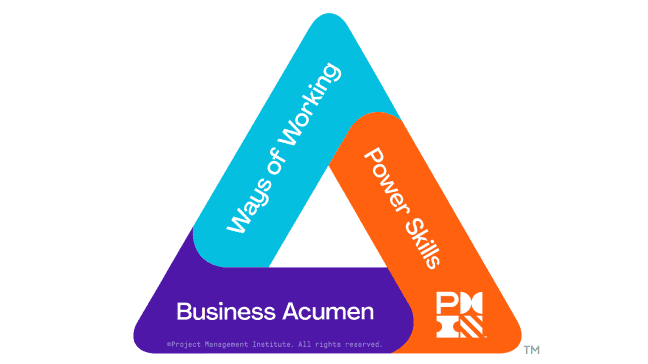
For example, the widely used Talent Triangle by PMI breaks down project management skills into 3 competency areas: way of working (e.g.: application of methodologies and tools), power skills (e.g.: communication, empathy, conflict management, etc.), business acumen (e.g. business understanding, value creation, strategic thinking).
The Competence Baseline used by IPMA uses the elements of People (soft skills), Practice (hard skills) and Perspective (strategy, sustainability, governance).
Project management soft skills
Whatever your level of experience, it is essential to have certain soft skills. Communication is one of the pillars of becoming a successful project manager, as it is both the most important skill for a project manager and a key factor in the success of a project. It is also closely linked to delegation and escalation skills, negotiation, conflict management, problem solving, time management and, in many cases, support roles (as mentor, facilitator).
As developing soft skills is a long and learning journey, it is worth making a conscious start at the beginning of a project career. Already at the level of project assistant and project coordinator, it is important, and almost essential as a beginner project manager, that employees are able to communicate effectively, including conducting meetings and workshops (formal, structured, verbal / semi-verbal). They need to understand what it means to work time-consciously, effectively self-organise and work effectively as part of a team.
As a junior project manager, when team leadership and delegation is no longer an option but an obligation, one needs to be familiar with the different leadership styles and how teams of different composition and experience evolve from the beginning to the end of the project and how to best lead each team and keep them motivated and sustained throughout the project. Motivating individuals is a very complex task, as there are as many people as there are inner worlds and inner driving forces. In order for a project manager to be able to identify the needs and individual motivators of each team member, social awareness and empathy are essential - and individual awareness and self-control are a prerequisite. These issues are closely linked to the issue of EQ. Developed EQ, good communication skills, the use of a conscious leadership style: a particularly useful starter soft skill package for all junior project managers, which will be needed sooner or later in the course of our work, regardless of the organisation.

Project management hard skills
Of course, in addition to advanced soft skills, hard skills are also key to being a successful early career professional. The basic concepts of project management, knowledge of the toolbox (stakeholder management, project scope, schedule and cost management, risk management, change management, etc.) are the engine of the machine. There is no doubt that today, with IT support, appropriate software skills and the involvement of AI, many tasks can be simplified or even replaced, but without the knowledge of the background of the processes, the work is not sustainable in the long term.
The situation and expectations are further complicated by the different application of different methodological approaches. We have now reached the point where project managers are increasingly expected to be able to use agile tools, to understand and know what incremental delivery means, not to be confused when a supplier mentions daily standups, and to understand the differences between methodological approaches and recognise which one is more advantageous in which environment and situation.
From the above, it may seem that a professional level of project management is expected from junior project managers, but the reality is that there is increasing competition in the labour market at this level, companies are increasingly "throwing" junior project managers into more complex situations and it is in the interest of the junior project manager to be able to handle these with as much knowledge as possible.
What can we expect from soft- and hard skill development project management training?
Experience shows that both soft and hard skills can be developed and learned. Different types of training can be of great help, but the expected results vary depending on the type of training.
Hard skill development, the so-called methodological training is perhaps the easier and faster development process, where we can learn the application of methodological tools through intensive courses, and even try them out through practical examples and cases. These skills can typically be integrated into daily practice within a very short time.
The acquisition of hard skills can be acquired through a variety of training courses as a beginner, the purpose of learning determines which course is the most ideal choice. If the goal is practice-oriented training, with a focus on simulation-based problem-solving, we recommend the Project Management Basics - Practical skills for beginners. If the aim of the education is to provide the participant with a broader internationally accepted theoretical knowledge or to structure his/her existing knowledge, the CAPM exam preparation course may be the ideal choice, which can be followed by the opportunity to obtain an internationally recognised qualification, independently. Later on, with the knowledge of hard skills, it is recommended to become familiar with certain IT tools to increase efficiency, which will greatly contribute to making work faster and more transparent. Our Digital Project Management Basic IT Tools training introduces participants to the most popular project management IT tools.
The development of soft skills is a more difficult issue, as all experts generally agree that the development of soft skills is not a 1-2 day training, but a much longer process. This is also because communication skills useful in the workplace are strongly linked to individual self-awareness and openness to self-development, which is unique to each individual. Training in this area can help participants to understand the specific tools for skills development and the possibilities for their own development paths in relation to these. The trainings provide guidance and input in a safe space for project leaders to start looking beyond the methodological elements of their work to soft skills, to recognise situations where conflict management, communication or even motivational tools are needed and to start applying them in a situation-appropriate way.
The Our PM toolbox training provides tools specifically designed for time management, facilitation, engagement and meeting/workshop facilitation for novice project managers, while Project communication that works our training focuses on collaborative communication, conflict management and reporting tools.
We recommend that all project managers, from beginners to advanced project managers, draw up an annual development plan, trying to identify which areas are the most important and urgent to develop, and which are the ones that can bring the most value to their daily work. To support this, we have prepared a ProMan Consulting project management training map, which can be a good starting point, categorising by level the typical areas and training that we have found can help project managers.
If you have questions or are unsure about which direction to take in your professional development, contact us with confidence!
