
Written by Domonkos Végh, PMP, PRINCE2 Practitioner
PMP vs PRINCE2 Practitioner – Which Certification Should You Choose?
PMP or PRINCE2 Practitioner? The short answer is that it depends on what you are trying to achieve. Are you looking to develop your own project management capabilities, or are you aiming to improve the way projects are governed and managed across your organisation? In this comparison, we will present the approaches, strengths, and typical use cases of the two qualifications, and help you decide which one aligns better with your goals.
PMP or PRINCE2 – Prerequisites and Exam Requirements Overview
There are significant differences between the two certifications, not only in terms of approach but also in entry requirements and exam structure. While PRINCE2 Practitioner primarily assesses knowledge of the methodology and the ability to apply it, PMP also expects practical experience in project management from applicants. Consequently, PMP is generally a relevant target for more experienced project professionals, whereas PRINCE2 can be obtained more quickly by those who primarily wish to familiarise themselves with a structured project management framework.
Aspect | PMP® | PRINCE2 Practitioner® |
|---|---|---|
Certification body | Project Management Institute (PMI) | PeopleCert |
Prerequisite | Project management experience and 35 hours of training | One of the following existing qualifications: CAPM, PMP, PRINCE2 Foundation, PRINCE2 Agile Foundation, PRINCE2 Agile Practitioner, IPMA Level A, B, C or D.
Of these, PRINCE2 Foundation is most recommended for effective preparation. |
Professional experience required | Yes | No |
Mandatory training | Training delivered by PMI ATP | Not compulsory, but highly recommended |
Exam focus | Project management competencies, situational decision-making, people, processes, and business environment | The practical application, tailoring, and governance logic of the PRINCE2 methodology |
Test type | Situational, case-based questions | Scenario-based questions focused on the practical application of the methodology |
Exam length | 230 minutes | 150 minutes – non-native English speakers are given 25% extra time, so approximately 188 minutes are actually available. |
Number of questions | 180 questions | 70 questions |
Can I use supplementary materials? | No | Yes, the official PRINCE2 manual can be used according to our individual preference, either in digital or printed form. |
Qualification validity | To be renewed every 3 years – by collecting 60 Professional Development Units (PDUs) over 3 years | Renewable every 3 years by collecting 20 Continuing Professional Development (CPD) points annually, or by obtaining a new PRINCE2 qualification, or by re-examination. |
They Address Different Challenges
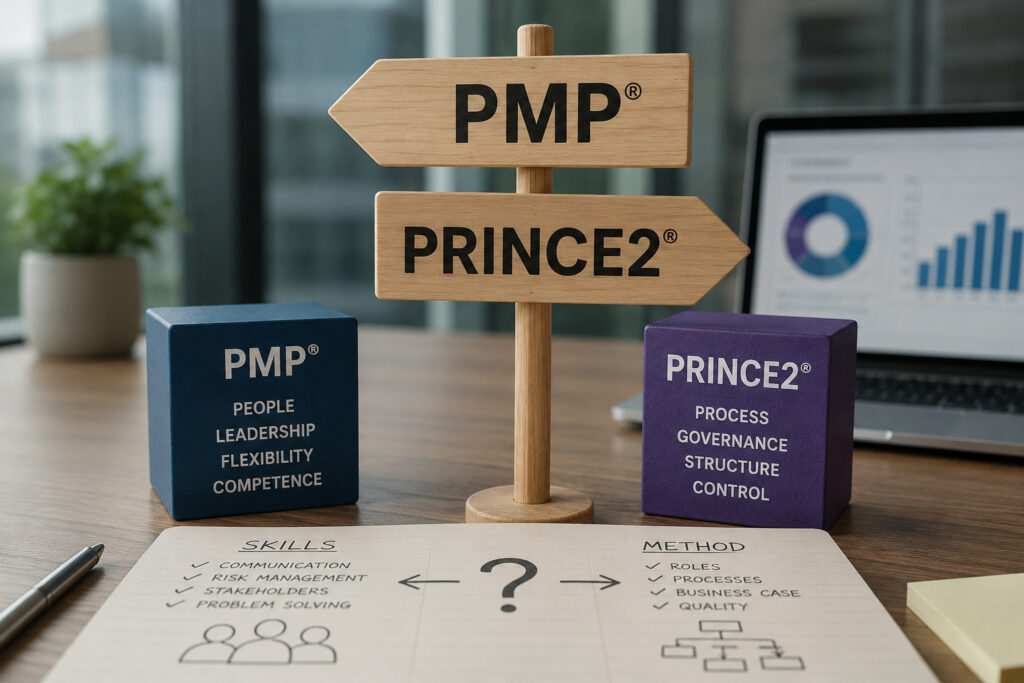
Among those deliberating between the two certifications, the assumption is often made that the two certifications are essentially the same, and the question between them can truly only be narrowed down to their marketing value or acceptance. However, like so many questions in the project profession, this cannot be simplified so easily. The theoretical framework behind the two certifications does not answer the same questions, nor does it approach project management from the same angle.
A simplified way of looking at the difference is this: PMP (Project Management Professional) primarily validates a project professional’s competence, toolkit and ability to make sound decisions in a wide range of situations, whereas PRINCE2 Practitioner focuses more on demonstrating the ability to operate and tailor a structured, controlled project governance framework built around clearly defined roles and processes. In other words, PMP approaches project management from the perspective of individual capability, while PRINCE2 approaches it from the perspective of structured organisational project governance. The meaning behind the PRINCE2 acronym reflects this distinction well: PRojects IN Controlled Environments.
This does not mean that PMP lacks a governance perspective, nor does it mean that PRINCE2 fails to provide practical project management knowledge. Rather, the emphasis of the two approaches is different. PMP places the project professional at the centre of its thinking. It focuses on how project managers think, make decisions, lead people, select appropriate delivery approaches and tools, and manage risks, stakeholders and change throughout the lifecycle of a project. The emphasis is on developing the judgement, adaptability and leadership capabilities required to navigate complex and often unpredictable project environments. PRINCE2, by contrast, places the project governance framework itself at the centre of its approach. The focus shifts towards how projects should be structured and governed, which roles and responsibilities should exist, how decision-making and escalation should be managed, when business justification should be reviewed, and how an appropriate level of control should be applied based on the project's size, complexity and risk profile. In simple terms, PMP primarily focuses on developing capable project professionals, whereas PRINCE2 focuses on establishing a structured and controlled environment in which projects can be successfully delivered.
A Brief History of the Two Certifications
This chapter does not aim to be a comprehensive historical overview, but it is still important for understanding the differences between the two perspectives, as many like to narrow down the distinction between the two to one being an American-centric but now globally growing organisation, and the other being from the United Kingdom, and therefore an accreditation more accepted in Europe.
PMP is a professional certification offered by the Project Management Institute (PMI) and forms part of PMI’s broader project management standards framework. PMI was founded in 1969 and incorporated in the state of Pennsylvania. Since its introduction in 1984, PMP has become one of the most widely recognised project management certifications in the world. Its original purpose was to establish a professional credential capable of validating a project manager’s experience, knowledge and leadership capabilities, regardless of industry, geographical location or the specific project management methodology being used.
PRINCE2, by contrast, originally emerged from the UK government sector and was introduced as a structured project management methodology in 1996. Its development was heavily influenced by the need for a more controlled and transparent approach to project management, based on clearly defined roles and decision points. As a result, PRINCE2 has historically been more closely associated with organisational project governance, stage control and the continuous validation of business justification. The rights to PRINCE were originally held by a government-backed organisation called AXELOS, which was later acquired by PeopleCert, the current owner of the framework.
A Closer Look at PMP
It is important to emphasise that the PMP is not an examination of a specific methodology. It is not about following a predefined project process or project management method step by step. Rather, it is a broad project management competency framework that assesses whether a project manager (or, more precisely, a project professional, in PMI terminology) is capable of thinking critically and making appropriate decisions in a variety of situations.
In the PMP approach, key themes include leading people, team management, conflict resolution, stakeholder engagement, communication, managing risks and issues, maintaining focus on business value, and selecting the appropriate project methodology. This is particularly important in environments where the project manager does not work according to a single rigid methodology but must navigate between predictive, agile, and hybrid solutions, or even combine them. The PMP does not aim to provide a universal project management guide, but rather a deep toolkit from which a professional can draw to decide for themselves what would work best in a given situation.. You need to manage an infrastructure project, a business transformation, software development, or a highly uncertain innovation project differently. The value of PMP lies in providing a broad professional foundation for these vastly different project environments and the related, situational decisions.
Therefore, obtaining the PMP certification can be valuable in alignment with individual project management development goals. It is beneficial for those who have to work on multiple projects, across different industries, in various organisational settings or with diverse methodological approaches. However, the PMP does not provide a ready-made corporate project management system, although it is true that it does not ignore the issue and recognises and expects high-level rules of thumb and general practices. Nevertheless, it is stronger in providing a robust professional mindset and toolkit, the application and use of which are based on the individual decision and judgment of project professionals.
A Closer Look at PRINCE2
A PRINCE2 Practitioner certification focuses on the knowledge and practical application of a structured project management methodology. PRINCE2 not only asks what a project manager should do well but also how the project management system itself should be structured, and what tasks and responsibilities lie with the client side (in PRINCE2 terminology „User” or „Senior User”), the sponsor („Executive”), the professional leads („Senior Supplier”), and the managers of specialist teams („Team Manager”). It also covers responsibilities such as Project Support or Project Assurance. This clarity of roles can be particularly valuable in organisations where projects don't falter or get delayed due to insufficient project management knowledge or tools, but rather because it's unclear who makes decisions, who approves, who escalates, who represents the business side, and who is responsible for professional delivery. PRINCE2 builds heavily on clear roles. A good illustrative example is that they have specific expectations and rules about who should compose the „Project Board,” i.e., the group that provides primary oversight for the project and is responsible for high-level decision-making.
Another strong element of the framework is dependent upon built-in decision points, mandatory project phasing, Furthermore, the stages are mandatorily sequential and cannot overlap in time (in this, PMI is more lenient). Alongside these, PRINCE2's characteristic features are its continuous reliance on business justification and control mechanisms. The key principle is that the project must have a continued business justification. This isn't just about creating a one-off business case at the start of the project, but rather asking these questions again and again throughout the project: Is it worth continuing this project? Will it still pay off? Can we realise the planned benefits and advantages? This approach is not alien to the PMI's perspective either; business justification is important to them, but the difference is that in PRINCE2, (with a bit of exaggeration) we can say that essentially everything is subordinate to this principle.
One of PRINCE2's most important strengths is its expectation of staged planning and execution. This means that the Project Board does not have to intervene in every operational detail, but can maintain control of the project within clear tolerance levels, and is given strong decision-making and control authority at least when stages change. If the project progresses within the pre-defined control ranges, the Project Manager can work independently, but if the project steps outside these parameters, escalation and management guidance and decisions are required. This may seem self-evident to many, but PRINCE2 defines specific expectations for the method, steps, and roles of escalation, as well as the types and content of associated reports.
The entire way of thinking is built on very strong governance logic.. It does not stop at the question of what the project manager should do, but also answers how the organisation should exercise control over the project.
PRINCE2 Is Not About Bureaucracy
Stemming from the above, a frequently raised criticism of PRINCE2 is that it is merely a tool for organisational bureaucracy and only serves to validate the need for excessive administration to senior management. It focuses too much on documentation, its processes are over-detailed and rigid, and comprise too many steps. I believe this criticism may be justified if the framework is applied incorrectly.
One of the fundamental ideas of PRINCE2 and fundamentally the need for customisation. The same depth and structure of governance should not be applied to a smaller internal development as to a multi-year, multi-country, complex transformation programme. The essence of PRINCE2 is not to force template documents, template roles and committees, or the same number of control points onto every project, but rather to tailor the extent of management and organisational control to the complexity, risk, size, and organisational importance of the project. Of course, there are fundamental expectations of the framework, but the extent of governance can be scaled up and down according to needs and requirements.
When applied correctly, PRINCE2 does not create excessive bureaucracy, but rather establishes the conditions for proportionate control.. It helps decide what decision points are needed, what roles must be involved, what level of documentation is required, and when management needs to intervene.
If PRINCE2 is implemented with the wrong mindset within an organisation, it can naturally become an over-managed, slow, and cumbersome system. However, it's important to note that this is not an inherent consequence of the method itself, but rather a failing stemming from a lack of tailoring.
Key Differences at a Glance
The key difference between PMP and PRINCE2 Practitioner, therefore, is that they have been optimised for different problems.
PMP provides the greatest value when the goal is to become a more capable and versatile project manager. It is particularly valuable for professionals who understand different delivery approaches, manage people effectively, navigate complex business environments, handle difficult situations with confidence, and remain effective even when projects do not follow a textbook process. That said, it is important to acknowledge the limitations as well. Perhaps the biggest limitation of PMP is that it does not provide a ready-made project governance framework. An organisation may employ many PMP-certified project managers, yet project initiation, prioritisation, approval processes, reporting and escalation mechanisms can still remain inconsistent. PMP strengthens the capabilities of project professionals, but it does not replace the need to establish clear organisational processes, roles and governance structures.
PRINCE2 Practitioner provides the greatest value when the objective is to make projects across the organisation more controlled, transparent and consistent. If multiple projects are running simultaneously but decision points are unclear, sponsor responsibilities are poorly defined, escalation paths are inconsistent, status reporting lacks standardisation, or business justification is not regularly reviewed throughout the project lifecycle, PRINCE2 offers a much more direct solution. However, the biggest limitation of PRINCE2 Practitioner is that, on its own, it is not as broad a project management competency framework as PMP. While it provides a clear operating model and governance structure, it does not develop leadership, negotiation, decision-making and methodological skills to the same depth. As a result, organisations that rely exclusively on PRINCE2 may strengthen project control and governance, but not necessarily improve the personal leadership capabilities of their project managers to the same extent.
In simple terms, PMP focuses on developing capable project professionals, whereas PRINCE2 focuses on strengthening the governance framework around projects and enhancing organisational project management practices.
Aspect | PMP® | PRINCE2 Practitioner® |
|---|---|---|
Underlying philosophy | Broad project management competence and toolkit | Structured Project Management and Governance Framework |
Primary focus | How should a project manager make decisions and operate effectively? | How should a project be structured, governed and controlled? |
Strength | Leadership, methodological, and business adaptability | Role clarity, decision points, control, phased planning and execution |
Organisational impact | Develops the professional maturity of project managers | Unifies project operations and governance logic |
Flexibility | Can be applied in various methodological environments | Can be tailored and scaled according to project needs |
Typical usage | Individual project management development, international career, hybrid environment | Standardisation of project processes, governance, regulated environment |
Potential limitation | No ready-made corporate project management model | It can easily become too process-oriented if it's poorly tailored |

PMP or PRINCE2 – when is it worth going for PMP?
The PMP is a better choice if our primary goal is to develop our individual project management competencies. This can be relevant, for example, in consulting firms, multinational corporations, regional service centres, technological environments, or in organisations where project managers work on a wide variety of project types. If someone wants a strong, internationally understandable project management qualification from a career perspective, the PMP is a stronger market signal. It is particularly useful if the project manager does not want to be tied to a single organisational methodology but desires broader professional scope.
The PMP is also a good choice if the biggest problem in an organisation isn't the lack of a unified project process, but rather that project managers work with different levels of preparation, different maturity, and different leadership skills. In such cases, the PMP approach can help create a common professional foundation, without immediately having to implement a full corporate governance system.
PMP or PRINCE2 – when is it better to go for PRINCE2 Practitioner?
A PRINCE2 Practitioner is a stronger choice if we want to strengthen or even unify the organisation's project operations. If projects are initiated ad hoc, if the roles of sponsors are unclear, if management decisions are made late, if status reports are not comparable, or if there is no clear escalation mechanism, then PRINCE2 offers tangible support.
This certification can be particularly useful in regulated industries, financial, healthcare, infrastructural, or large corporate environments, where auditability is important., accountability, clarity of decision-making powers, and documented control.
PRINCE2 is also a good choice if our organisation wants to establish a Project Management Office (PMO) or a unified project methodology operation, and we are looking for a structured starting framework for this. However, it is important to note that PRINCE2 on its own is not a complete PMO solution or corporate process control. It provides a strong foundation for project governance and the standardisation of project processes, but portfolio management, resource management, capacity planning, financial prioritisation or a complete PMO operating model require separate planning.
Can PMP and PRINCE2 Complement Each Other?
In more mature organisations, the two approaches can complement each other well. For example, it's conceivable to have an operation where the organisation develops its project management system according to PRINCE2 logic, meaning clear decision points, roles, stage boundaries, tolerances, reporting rules, and business case-based control. Within this framework, however, project managers would use PMP-oriented competencies, such as strong stakeholder management, risk management, team leadership, agile or hybrid methodological decisions, and business value-focused thinking.
In such a combination, PRINCE2 provides the project management framework, and PMP offers depth for the project manager's operations. PRINCE2 helps ensure the project doesn't become an organisational black box, while PMP helps ensure the project manager truly leads the project, rather than just administering it.
This can be a strong combination in organisations where standardised governance and flexible, situation-dependent project manager decision-making are both important.
Summary
When comparing PMP and PRINCE2 Practitioner, the real question is not which certification is better, but which one is better suited to your objectives. If the goal is to be more prepared, versatile, and methodologically flexible as a project professional, then PMP is a better choice. If the goal is to have our organisation's projects managed in a more transparent, controlled, consistent manner with clearer roles, then PRINCE2 Practitioner is ideal.
The two approaches are therefore not enemies, but rather two different perspectives on the same world. One primarily develops the person, the other structures the system. The question of PMP or PRINCE2 should be decided based on the above.
Do you have any questions? Get in touch with us.
Still unsure which certification is right for you? If you would like expert guidance in choosing between PMP and PRINCE2, or if you are looking to improve your organisation’s project management maturity, request a free consultation HERE! You can also complete our free organisational maturity assessment or explore our project management training map.
Frequently asked questions:
What is the main difference between PMP and PRINCE2 Practitioner?
The PMP primarily develops the competencies of the individual project manager, including decision-making, leadership, and methodological flexibility. By contrast, PRINCE2 Practitioner focuses on structuring an organisation's project governance framework by defining roles, decision points, escalation procedures, and governance mechanisms. In simple terms, PMP develops the individual, while PRINCE2 strengthens the system.
Are there any experience prerequisites for the PMP or PRINCE2 Practitioner examinations?
The PRINCE2 Practitioner examination does not require candidates to demonstrate prior project management experience. Instead, holding an eligible prerequisite qualification—such as PRINCE2 Foundation, CAPM, PMP, or an IPMA certification—is sufficient. By contrast, candidates applying for the PMP examination must provide evidence of relevant project management experience.
Can I use reference materials during the PMP or PRINCE2 Practitioner examination?
The PRINCE2 Practitioner examination is an open-book exam, meaning candidates may use the official PRINCE2 manual during the test, whether in printed or digital format, depending on the examination provider's rules. The PMP examination, by contrast, is closed-book and does not permit the use of any reference materials.
Which certification remains valid for longer, and how can it be renewed?
Both certifications are valid for three years and must be renewed to remain active. To renew a PMP certification, holders must earn 60 Professional Development Units (PDUs) within each three-year certification cycle. A PRINCE2 Practitioner certification can be maintained by earning 20 Continuing Professional Development (CPD) points each year, obtaining a further PRINCE2 qualification, or retaking the Practitioner examination.
Which certification should I choose if I want to standardise project management across my organisation?
For this purpose, PRINCE2 Practitioner is generally the better choice. It is particularly valuable in organisations where project initiation is handled on an ad hoc basis, sponsor responsibilities are unclear, escalation processes are inconsistent, or status reports are difficult to compare across projects. PRINCE2 provides a structured framework with clearly defined roles, decision points, and control mechanisms, helping to establish a more consistent and governed approach to project delivery.
Which should I choose if I want to strengthen my career?
From a career perspective, the PMP generally carries greater international recognition, particularly in consulting, multinational, and technology-driven environments. It is especially well suited to professionals who work across multiple industries, methodologies, and organisational settings, rather than within a single corporate framework or project management system.
Is it worth getting both qualifications?
Yes. The two approaches complement each other well: PRINCE2 can provide the project governance framework through clearly defined roles, stages, and decision points, while PMP adds depth to the project manager’s capabilities in areas such as stakeholder engagement, risk management, and methodological decision-making. This combination is particularly powerful in organisations where both standardised governance and flexible project leadership are important.
How many questions are included in each examination, and how much time is allowed to complete them?
The PMP examination consists of 180 questions and must be completed within 230 minutes. The PRINCE2 Practitioner examination contains 70 questions, with a standard duration of 150 minutes. However, candidates whose native language is not English are entitled to an additional 25% of exam time, giving them approximately 188 minutes in total.
How much do the examinations cost?
The PMP examination fee is USD 655, or USD 405 for members of the PMI. Annual PMI membership costs USD 164. The cost of PRINCE2 examinations is typically included in the price of accredited training courses and, depending on exchange rates, is generally around HUF 160,000 plus VAT.
