
Written by: Zsolt Czimbalmos, PMP, PBA, ACP, DASSM
Beyond AI Implementation: Organisational Operations in the New Reality
If AI tools are already up and running in your organisation but something still feels off, this article is for you. We explore why this situation is perfectly normal and what can be done about it.
Table of contents
Over the past two to three years, some form of AI tool has appeared in virtually every organisation. In some cases it arrived as the result of a top-down decision; in others, a grassroots experiment gradually became standard practice. The technology has been introduced, but the organisation has not necessarily kept pace.
If you work somewhere where AI tools are already in use, yet something is still creaking -uncertainty, role confusion, tension within the team, or simply the feeling that "this isn't quite working the way it should"- you are not alone. This is entirely predictable, and at the same time it can be managed deliberately.
AI technology is already here, but the organisation is creaking
Who approves AI-generated materials? Who is responsible if a decision based on an AI output turns out to be wrong? Is it permissible to enter client data into the system? How should roles be reshaped alongside AI? Should we expect redundancies or retraining as a result of AI? One team is already working entirely on an AI basis, another is not using it at all, and frankly nobody yet knows which approach is best practice.
These questions are not technological in nature, yet they are important and require systemic answers.
What do international surveys show about AI and organisational outcomes?
A few research findings that illustrate the seriousness of the situation:
- 88% of organisations already use AI in at least one business function, yet only around 6% report measurable, significant business impact (McKinsey, State of AI, 2025).
- One third of organisations expect to reduce headcount in the coming year due to AI. (Stanford HAI, 2026 AI Index Report, Economy chapter, point 8)
- Whilst 73% of experts expect AI to have a positive impact on work, only 23% of employees share that view. (Stanford HAI, 2026 AI Index Report, Public Opinion chapter, point 5)
- 66% of senior executives believe traditional functions must change, yet only 7% report any meaningful progress. (Deloitte, 2026 Global Human Capital Trends)
- In 61% of organisations, the AI strategy only partially, or not at all aligns with actual operational capabilities. (Lucid, AI Readiness Report)
- Top-performing organisations are 2.8 times more likely to redesign their operating model. (McKinsey, State of AI, 2025)
- 42% of employees feel their organisation does not assess the human impact of AI at all. (Deloitte, 2026 Global Human Capital Trends)
The technology is therefore already available, but its effective application at organisational level remains unresolved.

There is precedent for this kind of change dynamic
It is not the first time that a major technological shift has moved faster than organisations can adapt.
The same pattern played out with agile transformations: processes changed, but roles, responsibilities, and culture did not follow. The result was Scrum ceremonies that did not genuinely function, and teams that operated within an agile framework whilst still thinking the same way as before. In professional circles, we called this "doing agile", as opposed to "being agile", which refers to truly adopting organisational agility as a mindset.
The similarity between AI transformations and the organisational dynamics triggered by Covid
Covid is perhaps the starkest example. In 2020, virtually everyone switched to remote working overnight. It was a shock, yet most organisations adopted MS Teams or similar solutions very quickly, because without them, work would have ground to a halt. The technology came first; only afterwards did companies begin answering questions such as: How do we collaborate effectively online? What do we do with unused office space? How do we support communication in a digital environment? There was, however, one important factor: organisations knew this way of working was temporary. It might last six months, it might last two years, but the restrictions would eventually lift. Of course, the pandemic also carried a strong cultural dimension, nobody could say whether organisational operations would eventually return to their previous state, or whether remote working would become a permanent fixture for the decades ahead.
In some respects, AI implementations and transformations follow a similar dynamic. A trend suddenly emerges, leaders sense the opportunity it holds, and everyone races to implement as quickly as possible, the first tangible step being the creation of a technological capability.
Then reality sets in: in 2026, there is no such thing as a purely IT project, and no technology implementation that leaves organisational structures untouched.
Experience shows that these tensions typically become measurable within 6 to 18 months: turnover rises, decision-making slows, trust erodes, value creation declines and at that point, addressing the situation is considerably more expensive than it would have been earlier.

How does AI affect individual roles within the organisation? - Typical examples
Over the past two years, we have been actively observing our clients' AI implementation experiences across internal and market-facing service providers, manufacturing companies, the energy sector, financial institutions, and retail. We have consistently seen examples of the following situations:
Project Manager (PM): An AI tool automatically generates a status report based on project data. But who checks whether the report accurately reflects reality? Who is responsible if the client makes a decision based on incorrect information? The PM accepts it, but how much of what the AI assembled does he or she actually understand?
Project Management Office (PMO): A portion of portfolio reports (resource estimates, risks, scenario analyses) are already being produced with AI assistance. The PMO knows the data is not always clean, but the process has become faster and nobody questions it. A kind of blind-flight situation develops: the output is regular, but its reliability is questionable.
Business Analyst (BA): The BA now uses AI to write process descriptions and requirements. It is faster than before, but who validates the output? The developer accepts it because it came from the BA. The BA accepts it because the AI generated it from the business requirements specification. Responsibility goes round and round, and ultimately lands nowhere.
Software developer: With the emergence of vibe coding, this is no longer just about code completion: entire features and modules are being generated with AI, often without the developer reading through the output line by line. One colleague works this way and closes three times as many tasks. Another codes the traditional way and has a deeper understanding of what they write. Who is the better developer? Who introduces greater risk into the system? Who is responsible for the code review when AI-generated code is submitted? How does a manager who is not a developer evaluate this?
Procurement Specialist: Market research and supplier evaluation are partly handled by AI. But who makes the final decision, and on what basis? If the AI's recommendation conflicts with human intuition, what is the process?
Marketing specialist: A large proportion of content is generated or assisted by AI. But who is responsible for the brand voice, accuracy, and legal compliance? Can the approval process remain the same as before?
Customer Service Representative: An AI-powered chatbot handles first-level enquiries. But when should a human take over? Who monitors whether the bot is responding correctly? What happens when a customer complaint arises from a bot response and does AI change the optimal headcount for the customer service function?
HR professional: CV screening, interview question generation, onboarding materials, all with AI. But who is responsible for the quality of hiring decisions? What happens if the screening algorithm is biased? And who plans for the roles that need to be created to replace those gradually being taken over by AI?
Sales Representative: Proposals, emails, and client summaries are written with AI assistance. It is faster, but the question of client data enters the picture: what data may be used, and in what way? What happens if an error slips into a proposal, and how can the client be made to feel they are not simply reading something generated by a machine?
Finance & Controlling: Monthly closes, forecasts, and reports are increasingly supported by AI tools. Faster and fewer manual errors. Yet when the CFO asks "Why did this line jump?", the finance professional sometimes cannot give a precise answer, because it was the AI that identified the connection, not them.
The 6 dimensions of organisational change following AI implementation
The concrete examples above make it clear that the questions point in many different directions. Some relate to processes, others to roles, IT security, culture, teams, or leadership. This is no coincidence: it is now evident that AI implementation triggers systemic change that fundamentally transforms the way work is done, the methods of collaboration, processes, and of course strategy.
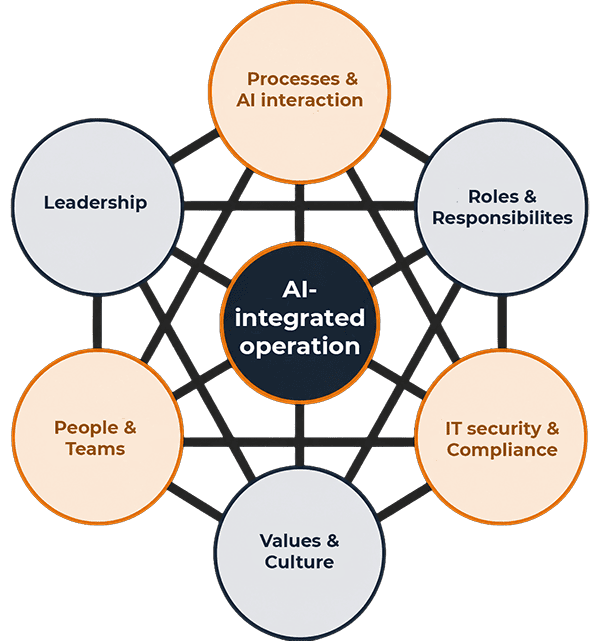
Based on our experience, the dynamics of change can best be described along the following six dimensions:
- Processes and AI interaction: where does AI enter the workflow, and where is human approval required? How should processes and their content be redesigned to achieve optimal, efficient outcomes?
- Roles and Responsibilities: who uses it, who validates, who is accountable for AI-supported work? What changes to job functions and roles are justified in light of the revised processes?
- IT security and compliance: what data may enter AI tools, and what rules apply? How can data leakage be minimised and information security principles be embedded into processes?
- Values and culture: AI implementation brings cultural fault lines to the surface. Do we value the colleague who produces three times the output with AI assistance, or the one who works more slowly but has a deeper understanding of the work? What message does the organisation send to those whose roles are gradually being transferred to AI?
- People and teams: what capabilities are needed, and how are hybrid human-AI teams structured? How do we plan for succession within the organisation? What is the ideal junior-mid-senior balance?
- Leaders: how do we manage hybrid teams, and where should human oversight sit? What should AI provide to leaders, and to what extent? What leadership skills come to the fore with the advent of AI?
These dimensions are interconnected: if one changes, the others will be affected. Addressing any single dimension in isolation produces only superficial solutions and in the longer term, no real solution at all which may result in a decline in the organisation's competitiveness.
The solution is not to be found in organisational silos
One of the most common traps is that different parts of the organisation all sense the tension, yet due to established silos and mindsets each seeks solutions only within its own remit, in isolation from the rest.
IT sees the security and governance questions and the technological challenges. It creates IT processes and establishes rules, but does not always see what is happening to people and teams as those rules are applied.
HR sees the uncertainty, fear, and role confusion in people, but does not necessarily have visibility of the process and accountability questions that are generating those symptoms. This is partly why organising a "How to prompt" training course will not be the solution.
Senior leadership sees the business objective and the technological opportunity, but does not see what is actually happening in teams at an operational level, or the tensions that are building in day-to-day operations.
Specialist functions experience the confusion on a daily basis, but lack the overview of the full picture and often lack the authority and support to drive systemic change.
It follows that this topic cannot be treated as the project of a single function. It is not a pure IT project, a HR project, or even a business project. Like the larger-scale transformations of the past, it will only succeed if the entire organisation implements this change in a coordinated and aligned manner.
The role of HR in the transformation: strategic focus in an operational world
A recurring thought has surfaced throughout the preceding chapters: AI implementation is not only about technology, it is about people. Indeed, it is more about people: about roles, fear, uncertainty, competencies, and culture. These are traditionally HR topics, yet in many organisations HR is not positioned to address them at a systemic level.
Digitalisation and efficiency pressure have reshaped the HR role in many organisations over recent decades. The focus has gradually shifted towards operational tasks: payroll, recruitment, administration, policy management. Meaningful interaction between HR and a manager often only occurs when someone asks what the rule is in a reward or disciplinary matter. HR is not solely to blame for this, it is the result of an organisational decision, one that now carries a cost.
AI implementation raises questions that operational HR is not necessarily equipped to answer:
- Which roles are most affected by automation, and what should happen to the people in them?
- What competencies will be needed in two to three years' time and should they be developed internally or brought in from outside?
- How do we plan for succession if certain junior roles gradually disappear, taking internal development pathways with them?
- How do we communicate honestly within the organisation about the human consequences of AI?
- What kind of culture do we want to build deliberately, and where do we position people within it?
These are strategic questions. Answering them does not require a policy, it requires an overview of the organisation as a whole, close collaboration with senior leadership and specialist functions, and the kind of trust that allows HR not merely to execute, but to shape.
A paradoxical situation has emerged in parallel with digitalisation and the rise of AI: whilst technology takes over an ever-greater share of tasks, the human factors, culture, trust, competence, motivation, are becoming increasingly important to organisational performance. Precisely those areas that have traditionally been, and should be, at the heart of HR's focus.
This does not, of course, make the change a "HR project", but in a successful transformation, HR must play a strategic role. Far more as an architect than as an operational executor. As a player who sees the people, understands the culture, and has the mandate to embed those considerations into organisational decisions.
Deliberate change management: why good intentions are not enough
It is clear from the preceding chapters that the organisational consequences of AI implementation cannot be managed within a single function or a single project. But knowing this does not make the change happen. Experience shows that the greatest obstacle is not a lack of will, it is that the change must take place simultaneously at three levels, and this is rarely planned for deliberately.
The 3 levels of organisational change triggered by AI implementation
Individual level
The arrival of AI is also a personal question for everyone affected. How does each person relate to it? Do they see it as a threat or an opportunity? How competent do they feel in using the new tools? Individual resistance, uncertainty, and fear cannot be resolved through communication alone, they must be surfaced, addressed, and given time to be worked through. If this level is skipped, organisational change exists on paper but not in reality.
Team and organisational unit level
Beyond individual adaptation, teams must also find their new way of working: how they collaborate with both human and AI participation, how internal processes, interactions, and accountability boundaries change. This does not happen on its own, it requires active thought and effort, and the outcome may differ from team to team.
Organisational level
Cross-functional collaboration is what makes change permanent. IT, HR, senior leadership, and specialist functions must operate according to shared goals and shared ground rules, otherwise siloed solutions return, merely in a different form.
Why a pilot, and not a big bang?
One of the best-known messages in change management is that large-scale transformations that attempt to change everything at once rarely succeed. The reason is that an organisation cannot simultaneously carry out genuine change at three levels across multiple areas, this frequently shocks the organisation, disrupts day-to-day operations, and generates even greater resistance. Capacity is finite, attention is divided, and at the first sign of difficulty, old patterns return.
Our pilot-based approach does not stem from caution alone. It allows us to test, in real conditions and within a selected area, what works and what does not incorporating the lessons before rolling out to the organisation as a whole. In our view, this produces faster, more cost-effective, and more sustainable results than a single large-scale transformation.
How do we begin the organisational change?
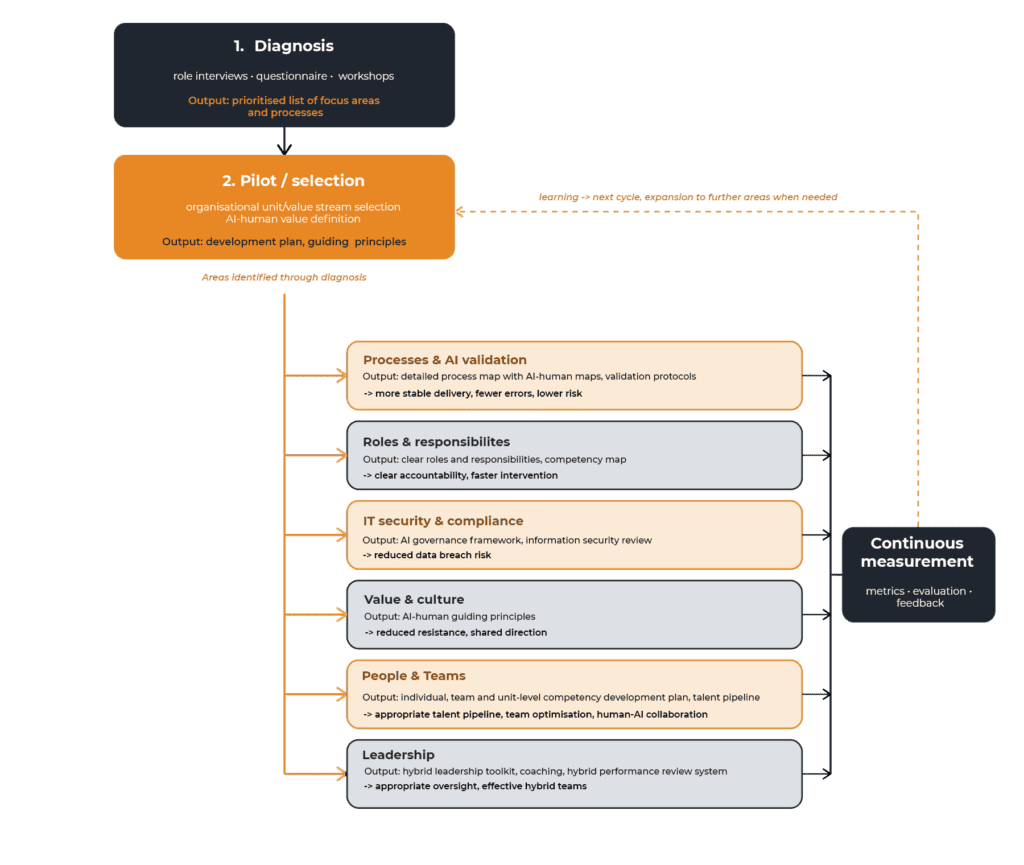
In our approach, the work begins with a rapid diagnostic that maps all six relevant dimensions simultaneously, through interviews with leaders and employees, questionnaires, workshops, and observation. The result is a prioritised picture of where tension is greatest and where it makes most sense to begin. We place considerable emphasis on ensuring the diagnostic is not excessively resource-intensive, we understand that what is needed here is rapid results and efficient delivery.
This is followed by a pilot within a selected organisational unit: we work in parallel across all three levels, individual, team, and organisational, alongside identifying the priorities within the six dimensions, continuously measuring and feeding back the findings. Based on the pilot's lessons, the approach is extended to the rest of the organisation, and pilot participants may take on the role of internal change agents.
Managing the organisational consequences of AI implementation requires knowledge that does not concentrate in a single area of expertise. This is precisely where our advantage lies: project management and agility, information security and compliance, process management, organisational transformation, training and organisational development. We have substantive experience across all of these areas and it is this that enables us to view and address the organisational consequences of AI implementation not from a single angle, but at a systemic level.
If you are curious about where your organisation stands, let us start with a free consultation. We will discuss the current situation, the greatest risks, and what the best next step would be.
Frequently asked questions about AI transformations
Why Is Implementing AI Technology Not Enough on Its Own?
Because introducing the technology and the organisation adapting to it are two entirely different processes. AI tools can be deployed quickly, but roles, responsibilities, processes, and culture do not change automatically. Uncertainty, role confusion, and tension within teams are predictable symptoms, and ones that can be managed deliberately.
What proportion of organisations implementing AI achieve measurable business results?
88% of organisations already use AI in at least one business function, yet only around 6% report measurable, significant business impact (McKinsey, State of AI, 2025). Technology implementation alone is not sufficient. Without transforming the organisational operating model, the potential of AI remains untapped.
What are the main dimensions of organisational change following AI implementation?
It is worth thinking along six dimensions: processes and AI interaction; roles and responsibilities; IT security and compliance; values and culture; people and teams; and leadership and governance. These are interconnected. If one changes, the others will be affected.
Why is it not enough for only IT or only HR to deal with the organisational impact of AI?
Because each function sees the problem only from its own angle. IT focuses on security and implementation questions but does not see what is happening to people. HR sees the fear and role confusion but does not have visibility of the process and accountability questions. The organisational consequences of AI can only be managed effectively through a coordinated, cross-functional approach.
What is the strategic role of HR in the organisational change brought about by AI implementation?
AI implementation is fundamentally about people: roles, competencies, culture, and uncertainty. In a successful transformation, HR must operate as a strategic architect, not merely as an executor. As a player who sees the people, understands the culture, and has the mandate to embed those considerations into organisational decisions.
Why is a pilot-based approach recommended for AI organisational change management?
Large-scale transformations that attempt to change everything at once rarely succeed: they shock the organisation and generate resistance. The pilot approach tests what works and what does not within a selected area, then extends the change based on those lessons. This produces faster, more cost-effective, and more sustainable results.
How should an organisation begin managing the organisational consequences of AI implementation?
The process begins with a rapid diagnostic that maps all six relevant dimensions simultaneously, through interviews, questionnaires, and workshops. This is followed by a pilot within a selected organisational unit, working in parallel at individual, team, and organisational level, with the approach then extended to the rest of the organisation based on the lessons learnt.
