
Organisational Development in the Age of AI
The challenge now is ensuring that operating models, roles and culture evolve alongside it.
Why is AI implementation alone not enough?
Almost every company is introducing or using AI. Technological implementation is taking place everywhere, and the direction of travel is becoming clear: workforce reductions, replacement of human labour, the emergence of hybrid human-AI teams, and ever-accelerating operations.
Organisations are gradually moving beyond the learning and implementation phases of AI adoption. However, these initiatives have so far typically focused on the technology itself.
Yet AI implementation fundamentally changes the way organisations operate and, whether we like it or not, affects organisational systems at a structural level.
AI-based solutions have spread at such speed that most organisations have had neither the time nor the opportunity to assess and consciously manage their organisational impact before implementation. The result is often organisational tension, even when the technological implementation itself appears successful.
What happens after you get in touch with us?
The impact of AI manifests itself differently in every organisation. During a free consultation, we identify the most pressing risks and conduct a rapid diagnostic assessment to determine where intervention is needed first.
1. Free consultation (30–45 minutes) — understanding where the organisation stands following AI implementation
2. Rapid diagnostic assessment — mapping the most affected areas and associated risks
3. Executive presentation — recommended intervention priorities and roadmap
4. Working together — step by step, in the agreed focus areas
Where are organisations now in their AI journey?
The pace of technological adoption is remarkable: the vast majority of organisations are already using AI in some form.
However, this speed has not been matched by organisational readiness. Most companies have implemented the tools but have not aligned their operations, responsibilities and processes accordingly.
A large proportion of organisations already use AI in at least one business function.
Where measurable, it also delivers significant business (EBIT) results.
The highest-performing organisations are 2.8 times more likely to redesign the way they operate.
The consequence is measurable: only a fraction of organisations realise the true business value of implementation, while the most successful organisations distinguish themselves by rethinking not only the technology but also the way they operate.




TRADITIONAL ORGANISATION
Traditional structure and way of working
AI
IMPLEMENTATION
Introduction and use of AI tools
ORGANISATIONAL TENSION
Role confusion, uncertainty, fragmented teams
AI-INTEGRATED ORGANISATION
A sustainable organisation optimised for AI




TRADITIONAL ORGANISATION
Traditional structure and way of working
AI
IMPLEMENTATION
Introduction and use of AI tools
ORGANISATIONAL TENSION
Role confusion, uncertainty,
fragmented teams
AI-INTEGRATED ORGANISATION
A sustainable organisation optimised for AI
Most organisations currently find themselves somewhere between the second and third stages. The technology is already present, but the organisational consequences are not yet being addressed consciously. Signs of organisational tension are already beginning to emerge: the labour market has become increasingly turbulent, more companies are eliminating roles, and there is growing evidence that this tension will become a measurable business risk in the near future.
Do these challenges sound familiar?

ROLE CONFUSION
People do not know what their role, responsibilities and authority are alongside AI.

FLYING BLIND
AI outputs are used without validation, creating significant business and reputational risks.

FEAR AND RESISTANCE
Fear of job loss and uncertainty associated with AI gradually turn into passive resistance.

COMPLACENCY
As teams become increasingly reliant on AI, independent critical thinking and soft skills gradually weaken.

LEADERSHIP BLIND SPOT
Leaders lack visibility of what is really happening within the organisation and teams, making it difficult to assess team capabilities and limitations.
PROCESS SKELETONS
Using old processes with fewer people and AI support can lead to chaos.
Which areas can AI affect?
The six elements of organisational performance — processes, roles and responsibilities, IT security, values and culture, people and teams, and leadership — function as an interconnected system.
When AI appears in one area, its impact almost immediately cascades into the others. A new AI-enabled process raises questions about accountability for outcomes; new responsibilities require new capabilities from teams; and new ways of working introduce new security and compliance considerations.
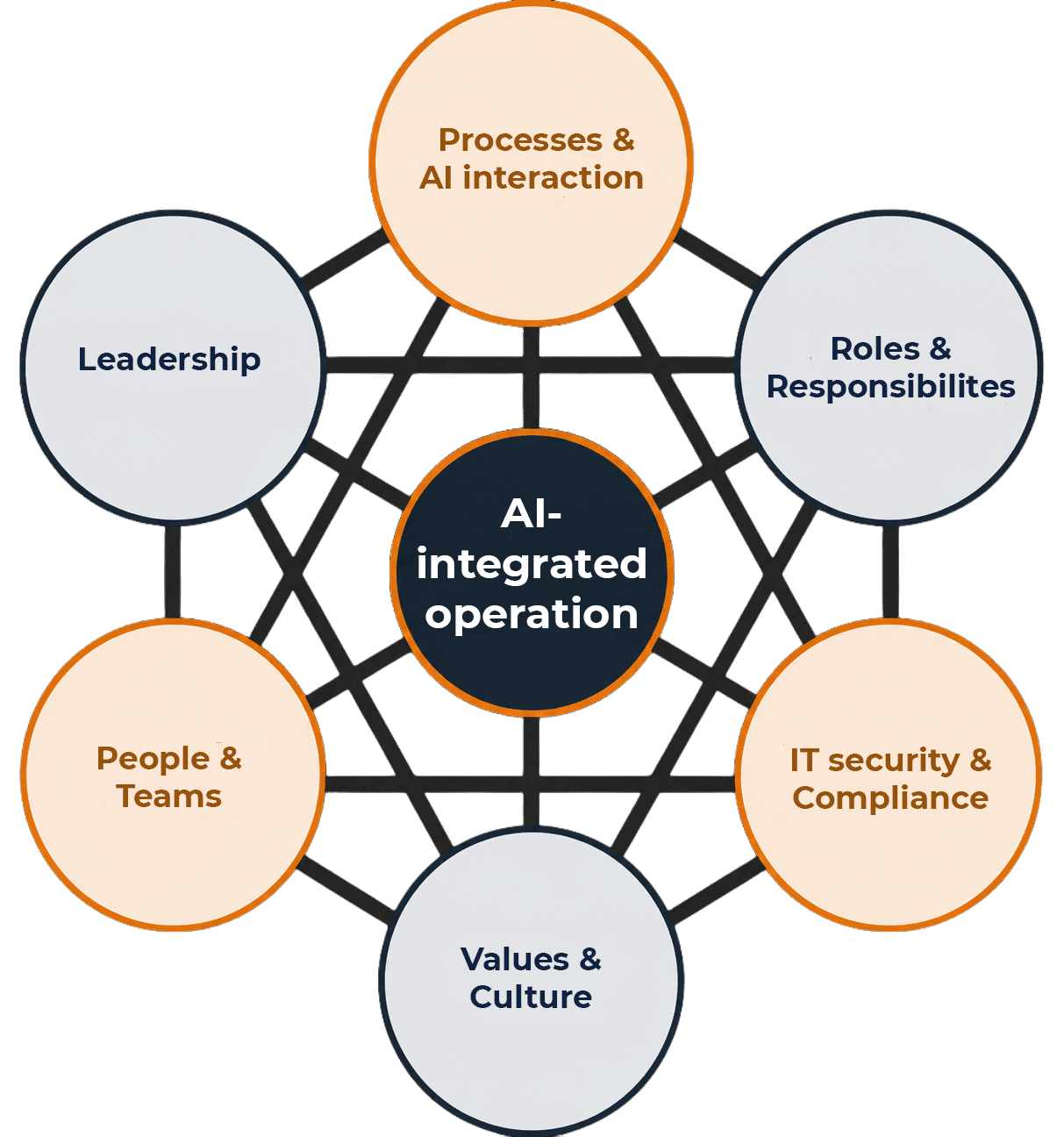
The six areas at a glance:
Processes & AIinteraction – It determines where AI enters the workflow and where human decision-making and approval remain.
Roles & Responsibilities – Clarifies who uses AI, who validates it, and who remains accountable for AI-supported work.
IT Security & Compliance – Covers what data may be entered into AI-based tools, where it is stored, who can access it, and establishes the framework for AI governance and regulatory compliance.
Values & Culture – Defines the principles according to which the organisation uses and expands AI, and how the human role is positioned within that framework.
People & Teams – Determines which capabilities employees need when working alongside AI, how knowledge is rebuilt, how hybrid teams should be structured, and how the organisation manages uncertainty and resistance associated with the transition.
Leadership – Helps leaders understand how to manage hybrid human-AI teams: where new control points and feedback mechanisms are required, and which decisions remain exclusively within human authority.
A five-step solution
Our organisational and operational development approach begins with a diagnostic assessment that identifies where risks are greatest and where development efforts should begin.
Focusing on a selected area, the work progresses through structured steps, and based on the lessons learned, the process can then be extended to other areas.
1.
Diagnosis
2.
PILOT / SELECTION
3.
DESIGN
4.
Implementation
5.
Continuous measurement



- Situation assessment
- Focus areas
- Priorities
- Value stream or unit selection
- Human-AI value definition
- Development plan
- Processes, validation points
- Roles & Responsibilities
- Capabilities and culture
- IT security & governance
- Implementation & integration
- Capability development
- Change management
- Metrics & Impact
- Feedback
- Continuous
improvement
1.
Diagnosis
2.
PILOT/SELECTION
3.
DESIGN
4.
Implementation
5.
Continuous measurement




- Situation assessment
- Focus areas
- Priorities
- Value stream or unit selection
- Human-AI value definition
- Development plan
- Processes, validation points
- Roles & Responsibilities
- Capabilities and culture
- IT security & governance
- Implementation & integration
- Capability development
- Change management
- Metrics & Impact
- Feedback
- Continuous
improvement
DIAGNOSIS
- Situation assessment
- Focus areas
- Priorities
2. PILOT/SELECTION
- Value stream or unit selection
- Human-AI value definition
- Development plan
3. DESIGN
- Processes, validation points
- Roles & Responsibilities
- Capabilities and culture
- IT security & governance
4. IMPLEMENTATION
- Implementation & integration
- Capability development
- Change management
5. CONTINUOUS MEASUREMENT
- Metrics & Impact
- Feedback
- Continuous
improvement
Our Lead Experts

Szilveszter Pálya

Réka Pétercsák

Domonkos Végh

Zsolt Czimbalmos

János Szendi Joó

Leila Varga

Dóra Szabó
Who can benefit from this service?
HR DIRECTOR
If AI implementation is creating uncertainty, resistance or retention risks, and there is a need to consciously redesign capabilities, roles and succession planning.
Transformation director
If AI implementation represents not only a technological change but also an organisational transformation, requiring deliberate redesign of the operating model.
COO/CEO
If AI implementation requires a rethink of organisational effectiveness, operating models and accountability structures in order to achieve sustainable business outcomes.
PMO Director
If AI is already present within projects and transformation initiatives, but roles, responsibilities and workflows have not yet been redefined.
CIO/CAIO
If an AI strategy or technology implementation is already underway, but organisational operations, governance and accountability structures have not yet adapted to the change.
Business Unit Director
If teams are already actively using AI, but it remains unclear how responsibilities, capability requirements and performance expectations will evolve.
Let's start with a conversation
As part of a free initial consultation, we will discuss where your organisation currently stands in its AI journey and identify potential risks and pain points. If required, we can then prepare a fixed-price proposal with a short lead time for the rapid diagnostic assessment.

