
Agile transformation in the organization - what is it about and what does it involve?
Agile transformation. This often used term may have different understandings by different organizations, different people.
- What does this mean, what lies behind this almost mystical term?
- What is the purpose? Why is it good or bad?
- Who can this be important to?
- How do we do it?
We will try to answer all your questions.
Overview
Agility, value and customer focus
Before we dive into the details, let's first interpret the words individually. Agility means vitality, speed, nimbleness, and transformation means a marked change in form, nature, or appearance.. So, agile transformation means that the organization is changed in order to be able to respond more quickly to change, so it is more vital and therefore more successful.
But what does it mean to be more successful? Success can be measured in many ways. In sales, profits, efficiency or simply in achieving the goals you set. However, it is probably fair to say that they all have one thing in common: high customer satisfaction. Every organization has customers, whether internal or external, so every organization serves or produces for someone.
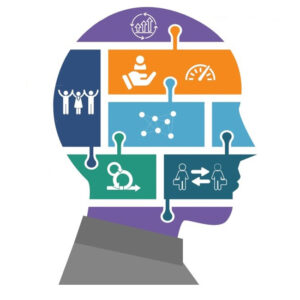
If the customers are happy, it is good for the organizations as well, as it increases their efficiency. This sounds simple enough, but it raises a number of questions:
- Do we know who our customers are and what is of value to them?
- Are we able to accept that customer needs are constantly changing?
- Do we accept that customers want results as quickly as possible?
If the answer to the above questions is yes, we have taken the first step towards understanding agility.
The understanding of agile organizations is far from the same, many people talk about agile methodologies, models such as SAFE, Nexus, or Spotify, agile projects, or even scaling, but this is just the tip of the iceberg.
What is agile transformation?
What is an agile organisation?
All organisations want to have faster decisions, quicker reactions to change, greater results, happier customers, higher efficiency, motivation and ability to create value. These are the elements that make an organisation successful, they make us better or different from our competitors.
These are not new things, we've been hearing these buzzwords for ages. This suggests that the agile organization is a buzzword that is very fashionable today, a buzzword that only changes the "packaging", less so the objectives.
If we can get beyond this and look at the objectives, we can answer the question of what are the main characteristics of an agile organisation non-exhaustive list:
- Desire to develop continuously
The above objectives show that agility is not a state, the bad news is that we never reach a state where we can lean back. There is a constant need to develop and improve and the organization accepts this and wants to support it. - Customer satisfaction and values
An agile organisation is characterised by its desire to deliver value. And value is what the customer perceives it to be. Will the client be better off if we spend hours a day on meetings that are actually completely unnecessary for half of the participants? No. - Networks instead of hierarchical structures
Such organisations are able to go beyond hierarchical, multi-level functioning. We have seen examples where an employee wanted a new mouse and it took two weeks to get approval. Yes, two weeks for an item costing about 10 EUR. This is obviously a corner case, but the same can occur in decisions, information flow, or any other process. - Trust and cooperation
One important element is to increase transparency, which only works if people work together and trust that everyone is working towards the same goal. - High motivation and creativity
Problems often require unique answers as a solution. This requires motivated people and creativity, not a foosball table and bean bags.

Areas often affected by Agile transformations
To strengthen the above characteristics, change is most often needed. In most cases, this change is not limited to one element, in our experience in most cases the following areas should be addressed:
- Strategy - - Let there be commonly agreed goals and visions
- Structure - Make the organisation clean and flat, speeding up communication
- Daily operational practice - There should be clear roles, responsibilities and any standardised processes should be shaped by the people working in them
- Infrastructure - Create an open physical and virtual environment, put the right tools in people's hands
- How to cooperate - Building a community that is about cooperation, about working together
- Knowledge sharing - Let's provide opportunities for knowledge sharing, emphasise its importance and try to become a learning organisation
- Leadership - Let us let go of autocratic instruments, but at least reduce them, empower people, support them, motivate them
- Culture and mindset - Let's develop people, their mindset, strengthen the task culture and reinforce the value focus, build a culture of feedback into the organisation
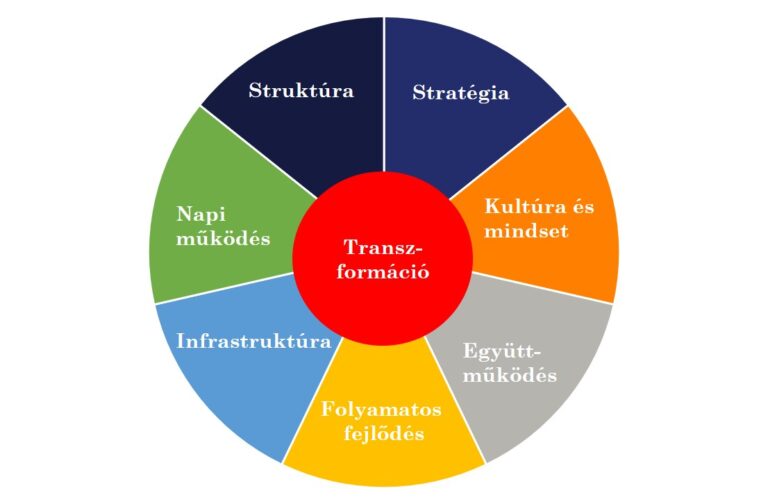
The above elements illustrate that such a change can radically stir up the life of the organization, a process that should be carried out very carefully. In our experience, developing a culture and mindset is the hardest part. We often hear that organizational culture needs to be improved. However, culture does not automagically change, because organizational culture is shaped by the people who work in the organization, consciously or unconsciously.
Organizations evolve organically, so our approach is to the development of corporate culture can be achieved through the improvement of processes, the way tasks are performed, decisions are made and the interactions that accompany them.
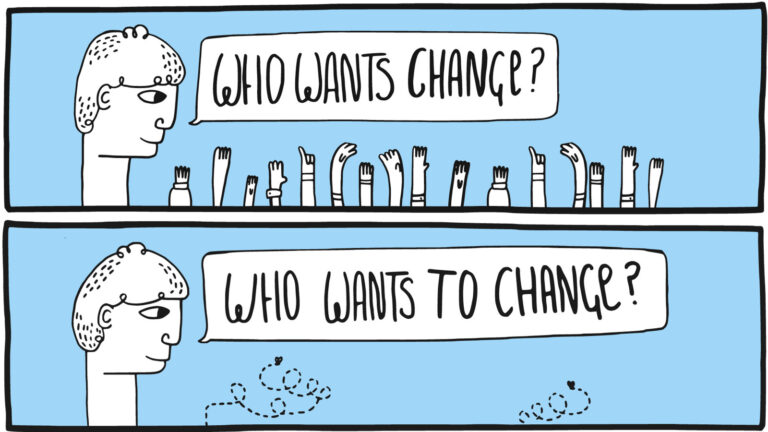
The power of motivation
In processes like this, there is a lot of talk about motivation. No change can last if people don't want it. For agile values to take hold in organizations in the long term, you need motivated employees.
So the eternal question is. what motivates individuals? Of course, there are also many theories, but they all agree that not just the salary. Material things are important, but they are not the only thing that matters. Many organizations try to add other elements to this, seek to provide staff with professional development, rewards, career paths, a professional environment, work-life balance and recognition.
According to modern approaches, while these are important, the motivation of employees is fundamentally determined by something else: how they experience work. Making daily work a reality, just as marketing professionals have recognised that it is not a car that needs to be sold to customers, but the experience of driving it.
This is what we are striving for in Agile transformations. We try to shape the day-to-day work so that employees get an experience that has close interaction, involvement, co-creation and networking .
When is the organization ready for a transformation?
The question often arises: when is it worth starting such a change? We usually say that it is when this need has also been raised by those in management and implementation roles in the organization.
If we take a more scientific approach, there are several stages and maturities of organisational agility.
In general, it can be said that initially, many organisations have authoritarian, hierarchical features, where customer needs are met in siloed operations, typically without asking for feedback.
With the organic development of the organization strengthening the product, focusing on value , so the organization often learns to think in smaller units, to deliver sub-products and modules, followed by the realization that continuous, or at least more active, communication and cooperation with the customer is necessary.
The first agile teams appear, who are now more empowered to independently try to add value to the client.
Typically, this is the point - if supported by managers and staff - where the organization starts to think about how this kind of empowerment and operation could be implemented in the daily life of the organization, so this is when a transformation can start in most cases.
If this change is successful, the organisation will become more agile, faster and we can reach a learning organization, which is constantly evolving and learning, and individuals working in the organization will be at the heart of this.
Pitfalls of the change
Such a major change brings many pitfalls and risks. In our opinion, the most important task of external consultants, coaches and change agents is to mitigate these and bring them to the attention of the organization at the right time.
The most common pitfalls we have encountered in our work are:
- The organization loses momentum in the process of change, loses motivation and gives up
- Initial failures - There will be setbacks which cannot be avoided, but the organization must learn from them and continue.
- Staff turnover - The big question in change is always what to do with the ones who have drawbacks from change? We can try to reduce their numbers, but it is to be expected that some will leave.
- Customers - In order to be more agile, we need to support our customers, which is often a difficult process and they need to be trained and supported.
- Managerial interest interference - The transition can bring a series of changes that can change the lives of managers. These may be unpleasant for them (e.g. loss of power), but their personal goals are more important than the organizational goals.
- Forcing - Models that work elsewhere may not work in our organization, so don't force change or out-of-the-box solutions on the organization.
- Recruitment difficulties - With change, there is a good chance that the mix of competences required will change or even expand, so recruitment processes need to respond to this.
- Capacity - Change can also mean a lot of energy and work for those working in the organization. In all cases, the aim is to redirect this energy away from core activities and away from processes that are currently redundant and add little value.
- Infrastructure - The changed operation may require different team locations, equipment and infrastructure, which may mean new tasks and associated costs.
- We want to implement everything using agile working methods - He who has only a hammer sees everything as a nail. Let's not try to have every project implemented according to agile methodologies! If traditional trends are appropriate, use them, it can make an organization more agile!
The latter element is one that needs to be emphasised, in many cases we find that organizations treat agile organization and agile project management as synonymous, as a single, overarching methodology.
Let's not try to solve every task or project with agile methodologies!

How can we support such a change?
As we change, the tools we use change, because we know from experience that a different approach is the right one for every situation.
Nevertheless, in our experience, the following actions need to be taken to ensure successful change:
- Survey, recognition
It is impossible to give an informed opinion without knowing the organization and the people who work in it. This process of getting to know the organization goes virtually all the way through the change process, and alongside it we seek to map the agile maturity of the organization. The purpose of this period is to identify the most critical things that hold us back and to understand exactly what are the critical processes that deliver real value to customers. - Defining our own operations and goals
Based on the survey, we propose to launch the process along specific objectives. The way we operate here will change a lot, but our experience shows that we need a starting point to set the main directions. It is critical that both managers and staff are involved in the process, in many cases self-organising teams are developing the directions of change with our support. - Pilot team and operations
Apart from a few rare cases, we recommend a step-by-step change. Following the modus operandi described in the previous section, a pilot period can be launched, where a pilot team will experience the benefits and challenges of the change. During the pilot period, it is critical that the team continuously improves and fine-tunes the initial concept based on the experience gained, as well as gaining its own experience, so that its members can later play an active role as agents of change, as internal facilitators of the process. - Extension
With continuous communication and transparent promotion of results and failures, as the pilot team gains more experience, it can be shared with other areas and teams, and the change can be extended. Our experience shows that with appropriate change management and coaching and other support processes, this hurdle can be overcome. - Ongoing support
To ensure that the change is not temporary, we support the process with on-the-job and coaching support until we reach a stage where the organisation is able to develop independently without external support.
In all cases, the above process is supported by trainings, workshops, individual and group coaching, and sometimes e-learning materials, which are implemented along a developmental plan. Initially, learning the basics and theory, followed by simulations, team coaching to process the experience, and finally individual coaching sessions are usually given greater emphasis.
We feel that our strength is that our staff have experience in organisational development and change management in addition to traditional and agile projects, so we are able to work with our clients to develop unique, tailored solutions. We don't believe that agile is the solution to everything, we try to actively incorporate common sense and simplicity into the solution directions we propose.
