

What is agile coaching? The role, tasks and types of agile coach
Agile coaching is an organisational development and business coaching activity that supports teams and leaders in implementing, developing and sustaining agile operations. The goal of the agile coach is to enable the organisation to create value independently, based on agile principles.
The agile coach has a major role to play in introducing agility and supporting agile project managers. However, the role and responsibilities of the agile coach are still unclear to many.In this article, we explain what agile coaching is and what role an agile coach plays in an organisation.
What does a coach do and how is agile coaching different?
Coaching, in the International Coaching Federation's view, is a creative, thought-provoking, perspective-changing, partnership process that inspires clients to explore their personal and professional potential and achieve their goals.
Coaching tools can be used in almost any area of life, but the development of a specific area requires knowledge and professional experience from other areas in addition to traditional tools.
That is why there are now many types of coaching. Life coaching and business coaching are completely separate fields. Agile coaching is a special field of business coaching.

How does agile coaching work in practice?
Agile coaching focuses on the practical implementation and sustainable embedding of agile in the organisation. It is not just about methodological support, but also about mindset shaping and cultural transformation.
Agile operations aim to ensure that the organisation:
- react more quickly to changes
- work in shorter feedback cycles
- create greater transparency
- deliver ongoing business value
Agile coaching is therefore not only a tool implementation, but also a learning process in which teams and managers learn new ways of working.
Agility is a great way to make your business simpler, more efficient and to make the products and services you develop more responsive to the ever-changing environment and customer expectations. But agile transformation also brings many challenges. Often there is a lot of resistance to organisational change and culture change, but selecting and implementing practices that really serve the company's interests can also be a challenge.
What are the tasks of an agile coach?
Who has been here before training, the question may have arisen, since the Agile Coach and the Scrum Master often mentor, teach, facilitate and coach!
Coaching activities in both agile and traditional project environments, aimed at improving project management as well as the organisation of project work and teams, are often multifaceted and may include many of the activities listed above. A truly effective agile coach therefore draws on a wide range of competencies, depending on the context and the specific situation.
Lyssa Adkins describes it in a similar way: coaching in agile teams has a dual nature, combining coaching and mentoring.
An agile coach supports professionals in achieving their goals, while sharing agile experiences and ideas, and mentoring them in the proper application of agile principles.
Hence, coaching and mentoring combine competences to develop agile professionals to effectively create business value along agile principles (2010).
The main roles of the agile coach
As an agile coach, they are contracted to support the agile team and the organisation that wants to change. In practice, this includes the following areas:
- As a teacher – Training on the different methods, tools and frameworks.
- As a consultant - Professional support to address bottlenecks and improve operations.
- As a mentor - Sharing your own learning processes and experiences.
- As a coach - Leading processes and asking questions that help teams and individuals to explore new ideas and solution strategies.
Project coaching works in a similar way in a traditional project environment. Here, the specialist explores the functioning of teams and processes and uses various methods to help the client develop appropriate planning, implementation and follow-up methods.
How does the agile coach help the organisation?
- The agile coach helps to clarify the organisational goals, the steps to achieve them, and is a partner in their implementation;
- Contribute to the development of a tailored agile approach that fits the organisation's objectives;
- Accelerates the agile transformation by offering different agile tools and exercises;
- Helps organisations manage change and set priorities;
- Acts as a mediator between the management and the teams, thus increasing the level of coordination;
- The coach prepares agile teams to thrive even after the coach leaves.
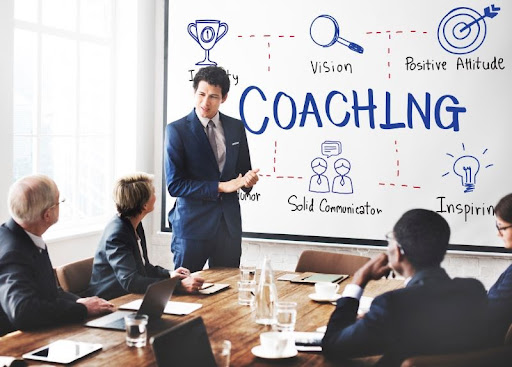
Types of agile coaching
Depending on the level at which the agile coach operates in the organisation, they can be differentiated:
- Agile team facilitator
- Agile coach working at multi-team level
- Agile coach for the whole organisation
In the following, we will describe the competency areas and tasks that an agile coach needs to be proficient in.
Agile team facilitator
An agile coach supports the work of an agile team by facilitating collaboration, strengthening the understanding of agile values and practices, and improving team productivity. A typical such role is the Scrum Master, but depending on the methodology the name may vary.
To be successful in this role, the following skills are essential:
- Deep knowledge and ability to use traditional coaching tools;
- Recognition of team dynamics and knowledge of tools to improve team functioning - because the agile coach works with the agile team throughout, there will be a very detailed and deep dialogue;
- You need to be able to motivate your team members, especially if you are introducing agility top-down, i.e. on the instructions of management - in which case the resistance of individual employees can be relatively high;
- It is fortunate if the agile coach also understands the technological implementation of development.
More information about the Scrum Master's tasks is given in this article.
Multi-team agile coach
It is common for an agile coach to work with several teams. In this case, the main objectives of his activities are:
- It helps to identify and apply best practices for teamwork;
- It supports the integration of teams into the wider processes of the organisation;
- Mentor team-level coaches, scrum masters;
- It helps to reduce the resistance of top management to the loss of control that comes with agile operation;
- Tracks and measures the results of the agile transition.
Although the skills of an agile coach at team level are needed in this case, more experience and insight into the whole functioning of the organisation is needed.
Enterprise level agile coach
If the agile coaching process is extended to the whole organisation, the coach is even less involved in facilitating day-to-day operations. Instead, the focus is more on transforming the corporate structure along agile principles and subsequently creating the structure needed to sustain it within the organisation. There is a strong emphasis on working with senior management, communicating agile principles to managers and making the benefits known.
In addition to the competences described above, there is a need for:
- Organisational operational and planning skills;
- Experience in organisational change management;
- Leadership coaching skills;
- Deep knowledge of Agile frameworks (e.g. SAFe, LeSS or DaD)
How to become an agile coach? Agile coach training courses
In practice, people who were previously project managers are often appointed as scrum masters as a first step. But it may also be the case that the move is from a software developer or product manager position, often not even to a full-time position. In this case, the employee spends part of his/her time in the new role and part of his/her time in the old role.
To successfully implement new tasks, a practice-oriented scrum master training simulating real-life situations or our tailor-made Agile Coach training can be of great help. About our Scrum Master training read more here.
General, role-independent knowledge and international certification is offered through our PMI-ACP exam preparation programme.
And for Senior Scrum Masters, our exam preparation course based on the PMI-DASSM Disciplined Agile framework offers a pathway to progression.
In the long term, agile coaching strengthens the organisation's adaptability and business effectiveness.
Frequently Asked Questions about agile coaching
What is agile?
The term “agile” means flexible and adaptable. In business and project management, it refers to an approach that emphasises rapid adaptation, continuous feedback and customer-centric thinking.
When should you bring an agile coach into an organisation?
It can be valuable to involve an agile coach when an organisation is starting an agile transformation, struggling during the transition, experiencing declining team effectiveness, or facing misalignment between leadership and team-level operations. An agile coach helps manage change in a structured way and accelerates organisational learning.
How long does an agile coaching process take?
The duration of agile coaching depends on the size, maturity and goals of the organisation. A team-level support can last a few months, while a complete organisational transformation can take several years. The goal is always to make the organisation self-sustaining.
Is an external or internal agile coach more effective?
Both solutions have their advantages. The external agile coach brings an objective perspective and extensive experience, while the internal coach has a better understanding of the organisational culture and operational specifics. In many cases, a combination of the two is the most effective.
What skills are needed to be a successful agile coach?
An agile coach must have coaching competences, organisational development knowledge, agile methodology knowledge and strong facilitation skills. Systems thinking and experience in change management are also important.
How is an agile coach different from a consultant?
While the consultant proposes specific solutions and points the way for implementation, the agile coach mainly supports the organisation in finding its own solutions. The aim of agile coaching is to develop long-term autonomy and the ability to learn.
Want to know more about coaching, individual or team development? Would you like to attend an agile coach training?
If your organisation is planning to implement agile operations or you are a professional looking to move into the role of agile coach, our training courses provide practical support. View scrum master and Product Owner our training maps, or contact us with confidence!
