
Scrum Master training - practical agile training with simulation
Learn how the Scrum Master role works!
The programme can be supplemented with PSM I exam preparation if required.
What is Scrum Master training about?
The aim of our Scrum Master training is to introduce participants to the basics of agility and the SCRUM framework and to provide a comprehensive overview of the Scrum Master role and the tools available. To do this, as a participant in our programme, you will need to experience and try out a real-life process through concrete situation simulations.
The Scrum Master is a very complex role. Its main purpose is to help the team to create value, define and apply the framework, and develop collaboration, whether in a project or organisational context. As every situation and team is different, the Scrum Master needs a strong toolkit, a deep knowledge of agile values and the right mindset, thinking and skills.
This training is designed for individuals and groups who are committed to effectively supporting agile teams, who prefer a servant leadership approach over a traditional management style, and who believe in the power of teams, creativity, and collaboration.
Find the programme on the training map:
Recommended for beginner Scrum Masters
Scrum Master training - practical agile training with simulation
We also offer online courses using digital and video conferencing tools!
Our experts
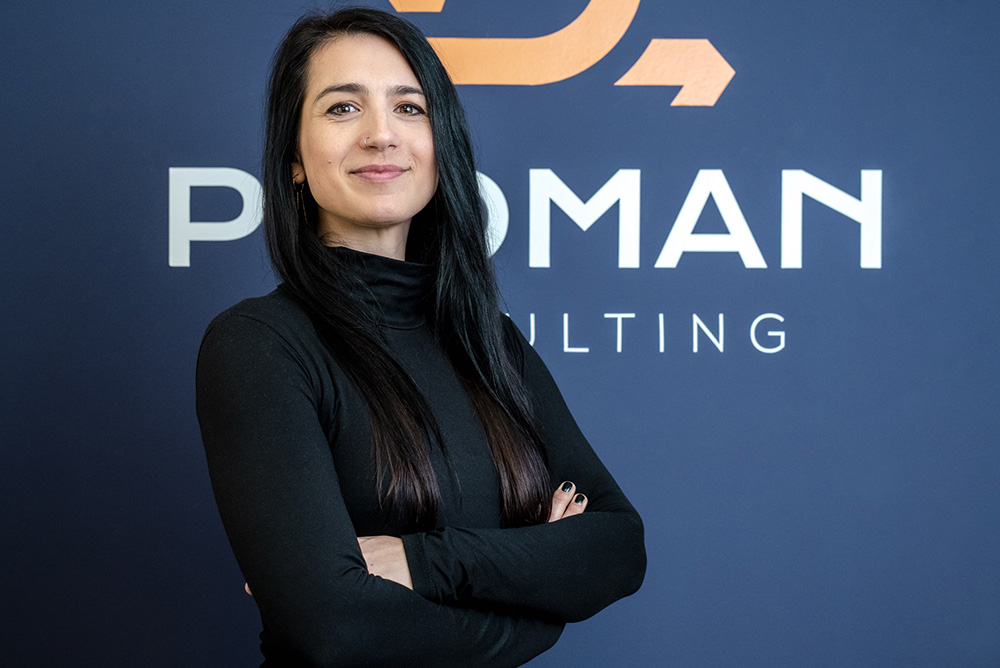
Réka Pétercsák
Réka has more than 10 years of experience supporting organisational and agile transformations. Her experience includes designing and implementing agile transformations, scalable operating frameworks, adaptive demand management processes. She also supports leaders and teams in navigating long-term mindset and behavioural change. As a trainer and coach, she has supported the development of more than 2,500 participants through agile, Scrum, SAFe, project management, and leadership development programs.
Prerequisites and framework for the Scrum Master course
During the programme we will also cover the basics of agility in detail, so participants do not need to have any prior agile experience.
Our 2.5-day programme is designed to focus on the essentials and practice:
- In our Training, we take participants on a journey from working on a new idea to creating and supporting a self-organizing team, during which they will encounter different situations and possible Scrum Master tasks.
- With our Simulation, they can try out a toolkit that will support them to effectively engage in team building, designing and developing operational frameworks, facilitating ceremonies and, finally, creating a real self-organising team.
Taking into account the intensity of the programme, the number of participants was set at between 4 and 10 people, which allows everyone to have the opportunity to experience the situations in the Scrum Master role.
The programme can also be delivered to teams, in which case the exercises, situations, and scenarios are tailored to the client’s specific needs.
Scrum Master exam preparation
If required, we will help you to obtain the Scrum.org Professional Scrum Master I. (PSM I.) certification within a 4-hour session after the training. The 4-hour additional module includes an 80-question exam simulation and its joint evaluation.
Training agenda
Agile basics
- When to use and what are the limits?
- What makes an agile team successful?
- How to learn agile? - ShuHaRi
- What is agility?
- Fail Fast, succeed faster!
- Stacey matrix and its practical application
- Agile Manifesto and its application through concrete examples
Changes to agile principles in the age of AI
Scrum basics
- Scrum skeleton - process and simulation
- Efficiency vs. effectiveness - Why is empiricism important?
- Scrum produktumok
- Scrum ceremonies
- Scrum roles
- Agile role-playing exercise
- Typical problems, constraints and possible solutions
- What is Scrum NOT for?
AI-Agile Knowledge Base: What should we read in the age of AI?
Scrum Master role
- Who is a Scrum Master?
- What does a Scrum Master do?
- Lyssa Adkins framework
- What does a Scrum Master NOT do?
- A typical week for a Scrum Master
- Scrum Master and team
AI-enabled Product Owner and Scrum Master
Agile process
- Agile projects vs organisation
- How can the Scrum Master support this process?
- Product Owner support options and toolkit
- Support for clarifying expectations
- Backlog building support
AI-Agile Frameworks: AI-Native SAFe and Scrum
Scrum Events
- Facilitating Agile events
- Case study: retrospective in practice
- Intervention tools
- Situational practice - promoting self-organisation, empowerment
Team support
- Team support and Tuckman model
- Coaching tools and practice
- Feedback management
- Dealing with conflicts
- Agile metrics (OKR, velocity, burn-down, cycle-time)
- Introduction of estimation exercises
- Team support tools, techniques
Satisfaction guarantee
We are fully confident in the quality of our training. However, if you are not satisfied and let us know on the first day, you naturally won’t have to pay anything! We only issue the invoice after the final session, we do not charge anything in advance.
Price and schedule of the Scrum Master training
The size of the group was set at 4-10 people to work effectively together.
*Discounts are available for members, for two or more participants, and for individuals! For 4 or more participants, we offer additional discounts on an individual basis, and the location and schedule can be flexible!
SATISFACTION GUARANTEE - we are confident about the quality of our programmes, but if you are not satisfied and you report it during your first session, of course you don't have to pay! The course price will be invoiced at the end of the programme, we do not charge anything in advance.
The programme is an intensive 2.5 day workshop based on elements and collaborative work, simulating a real process with real situations. The ratio of practical elements is about 80%.
Request a quote
Scrum Master training - practical agile training with simulation
Currently, we provide our trainings in English for corporate groups in dedicated online or onsite formats. The dates and prices of our open trainings in Hungarian are available at the following link:
If you are interested in English-language training courses, please request a quote using the form below or contact us at info@promanconsulting.hu.
quality
satisfaction
execution
"It met our expectations perfectly. It contained the right mix of lectures and exercises. The exercises were very good, they supported the theory well and made the point. The atmosphere was pleasant."
Important
Our programme is designed around best practices from real projects, providing practical support and first-hand experience in the effective implementation of agile projects.
10 reasons why you should choose us
- We only run small group workshops, larger groups are split up to ensure efficient learning
- Low minimum number of participants, unlike most training organisations, we start the course with as few as 4 participants, no waiting
- Qualified trainers - our trainers are CAPM, PMP, PMI-PBA, PMI-ACP, PSM, PSPO and SAFe certified, and our trainers are uniquely familiar with all major PMI, Scrum.org and SAFe exams, so they can provide strong support on the types of questions and tricks you can expect to encounter in the real exam
- Practical experience: our trainers have helped dozens of teams and organisations to become agile and have supported real agile projects, which will provide practical help in real-life situations throughout the programme
- Pay only after the training: no deposit is required, in all cases you will be invoiced after the end of the programme
- Satisfaction guarantee: we're confident about the quality of our programmes, so if you're not satisfied and you tell us at the first visit, you don't have to pay anything.
- Exam routine: participants will take a series of tests during the programme
- Real-life: the learning is delivered in a process-oriented way, supported by practical examples that match the participants' experience,
- Exam administration, documentation: support for all participants, individual consultation on request
- We also offer additional discounts on our affordable prices for individuals
Location
H-1118 Budapest, Kelenhegyi str. 29/b.
tel.: +36 20 333 0386
mail: info@promanconsulting.hu
Frequently asked questions about PSM certification:
Where can I get my Scrum Master certification?
There are several internationally recognized Scrum Master certifications, the most common of which is the PSM certification. The PSM certification can be obtained through Scrum.org.
What is the abbreviation for PSM?
PSM stands for Professional Scrum Master, one of Scrum.org's certifications. The same qualification is called CSM (Certified Scrum Master) in Scrum Alliance.
How is our Scrum Master training different from other Scrum Master training?
The training we provide meets international standards and our trainees pass the PSM exam. Our training courses are divided equally between theoretical and practical training, so that the knowledge gained can be immediately put to the test in real professional situations, helping to acquire and deepen knowledge.
What is the difference between PSM and CSM certification, which is recommended?
The PSM certification can be obtained through Scrum.org, has no prerequisites, currently costs 200 USD for the basic level and does not expire after obtaining it. The CSM certification can be obtained through the Scrum Alliance, with a prerequisite of attending a training course organised by the Scrum Alliance (1000 EUR+), so we recommend the PSM certification.
Who is the PSM certification recommended for?
We recommend the PSM qualification for those who want to work as a Scrum Master or who already have Scrum Master experience and want to prove their expertise by obtaining an internationally recognised, prestigious qualification. The PSM I qualification is ideal for those starting out in their career, career changers and those working in the industry.
What are the prerequisites for obtaining the PSM qualification?
There are no prerequisites for the PSM I qualification, but it is recommended to complete an exam preparation course.
I have completed the PSM exam preparation course, how long do I have to take the exam?
There is no such restriction. It is advisable to leave as much time as necessary between the course and the exam.
How long is the PSM exam code valid?
The PSM exam code is valid until used and has no expiry date. It can be used at any time after purchase, for as long as you want.
How much does the PSM exam cost?
The PSM exam fees are set by Scrum.org, which currently stands at $200 USD for PSM Level I, $250 USD for PSM Level II, and $500 USD per attempt for PSM Level III.
In which language can I take the PSM exam?
PSM I is available in English, Japanese and Simplified Chinese, PSM II and PSM III are available in English and Simplified Chinese. The exam can be taken using the Google Translate Plugin, which is recommended to follow the Scrum.org advice for successful use. However, Scrum.org points out that they cannot guarantee the quality of the translation.
How long is the PSM I exam and what type of questions does it consist of?
The PSM I exam is 60 minutes long and consists of 80 questions. There are three types of questions on the exam: true-false questions, single-answer questions and multiple-answer questions.
How does the PSM exam work?
To take the PSM exam, you need a computer and an internet connection. The first step is to register on Scrum.org and then start the exam with the purchased exam code. To pass the PSM I and PSM II exam, you must answer at least 85% of the questions correctly, and for PSM III, you will be individually assessed on your exam work, with a pass or fail result.
Are there breaks in the exam?
There is no break in the PSM exam, you must complete the exam within the time limit.
Can I try again if I fail the exam the first time?
Yes, you need to buy a new exam code.
How long is the PSM qualification valid?
The PSM qualification is a lifetime qualification, with no statute of limitations.
What is the difference between PSM I, PSM II and PSM III certificates?
The PSM I certificate demonstrates that the holder understands Scrum as described in the Scrum Guide and how to apply it in Scrum teams. PSM I holders have a consistent approach and terminology for Scrum. The PSM II certificate demonstrates the holder's ability to apply the Scrum framework as a Scrum Master, to support Scrum teams and to solve complex, real-world problems in professional life. PSM III certifies that the holder has an in-depth understanding of the practical application and values of Scrum. The exam assesses the Scrum Master's suitability in a variety of complex team and organisational situations. To obtain PSM III, a very high level of Scrum knowledge and extensive experience as a Scrum Master is required.
How long is the Scrum Master training that prepares me for PSM?
Our Scrum Master training is 2.5 days long, the first two days from 9:00-17:00, the third day from 9:00-13:00, followed by an optional 4-hour PSM coaching consultation.
