
written by: Réka Pétercsák, PSM, PSPO, SPC, PCC
Scaled Agility in the Age of AI: AI-Native SAFe®
SAFe® is among the first agile frameworks to announce the developments and framework changes it has introduced in response to AI. This article presents them, and is the start of our summary of what was covered in the official presentations published by SAFe®. Just as with the robust SAFe® framework itself, there is of course no need to adopt or integrate AI-Native SAFe® in its entirety. As a vast library and body of experience, SAFe® gives us the opportunity to learn and experiment with the options for introducing AI.
What Does the AI-Native Imperative Mean?
For individuals and organisations to remain competitive in the age of AI, they need to look at the role of AI in three ways. The first is getting to know AI technologies and using the tools at an appropriate level. The second is recognising that AI is more than a tool. It doesn’t just make our everyday tasks simpler and faster to complete; it also confronts us with the challenge of finding the new opportunities through which we can create business value. The third is ensuring that the money and other resources invested in AI tools and solutions deliver a return for the organisation. From our own conversations with Hungarian leaders, we can confirm the trend shown by the Return on AI Institute’s 2026 global survey of 1,006 senior executives across 11 countries: although 90% of organisations report some AI value, only 16% capture it systematically, and fewer than 1 in 10 see generative AI as their primary source of value.
Why Is This?
According to SAFe®’s presentation, one of the key findings of the research is that most organisations lack a unified, proven framework for introducing and operating AI. Our managing director, Zsolt Czimbalmos, wrote an article on this a few weeks ago. As a result, many organisations are experimenting with artificial intelligence, yet they are unable to create genuine business value from it.
Amid rapid technological change, organisations need structure and proven operating practices. They need a framework that helps them determine:
- which capabilities are worth developing,
- which processes need to be put in place,
- and how to strike a balance between team autonomy and appropriate governance.
AI-Native SAFe® serves exactly this purpose: it offers a framework that helps organisations introduce AI deliberately and consistently, so that it generates genuine business value. What is needed is a framework that builds on the existing process-oriented, experimental and adaptive mindset, since AI means these ways of working have to speed up.
So what do we need to consider in an AI-supported way of operating?
| Lean-Agile SAFe® | AI-Native SAFe® |
|---|---|
| Focus on outcomes | Focus on outcomes and intent |
| Cross-functional teams | Cross-functional, AI-augmented teams |
| Iterative learning cycles | Iterative learning and rapid experimentation cycles |
| Scaled development | Scaled development and innovation |
The right-hand column shows how these areas need to change for an organisation to operate in a truly AI-Native way.
Outcomes remain at the centre, but intent is becoming increasingly important too. AI needs to understand not only what we want to achieve, but also why. It has to know our business goals, how we operate and what our customers need in order to provide genuine help.
Teams are transforming: they are becoming AI-supported, often smaller, yet able to respond to change faster and more flexibly. You can read about the fascinating experiments of Jeff Sutherland, one of the co-creators of Scrum, here and on his LinkedIn.
Iterations remain important, but learning to work iteratively is no longer enough on its own. One of the keys to how modern organisations operate will be rapid experimentation: quickly trying out and discarding ideas, learning from the results, and then developing their solutions further on that basis.
Previously, the biggest challenge was how to scale development within an organisation. In the new framework, this is complemented by increasing innovation capability. The reason is that, thanks to AI tools, almost everyone in an organisation can now develop new ideas, build prototypes and contribute to development.
Naturally, SAFe® also underlines that all of this is made sustainable by a human-centred AI culture. Such a culture encourages the use of AI whilst recognising and preserving the value that only people can continue to add: creativity, judgement, empathy, ethical decision-making and genuine collaboration.
These four shifts in mindset also appear in the framework. Let’s look at them in turn:
I. Focus on Outcomes and Intent
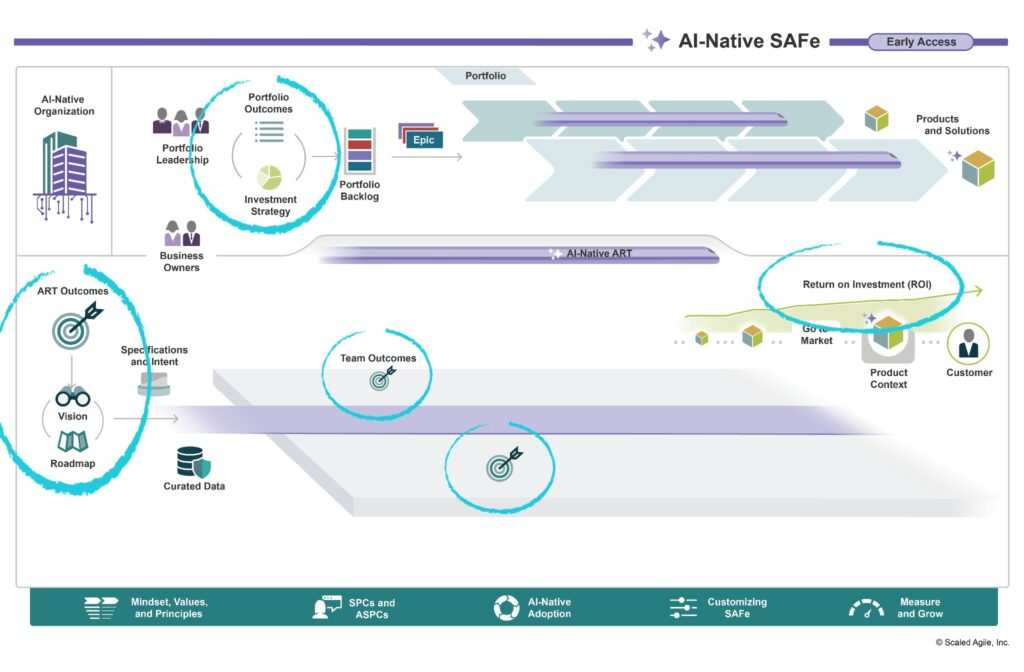
One of the most important shifts in AI-Native SAFe® is that the emphasis moves from the work to be produced (output) to the business results we want to achieve (outcome) and the underlying intent. With AI, development has accelerated, so the main question is no longer whether we are able to build something, but whether we are really building what creates the most value for customers and the business.
In the age of AI, then, development is no longer the bottleneck. The real challenge is building the right things. That’s why AI-Native SAFe® places the emphasis on business outcomes and the underlying intent rather than on the features delivered.
How Can We Make Sure We Actually Achieve These Outcomes?
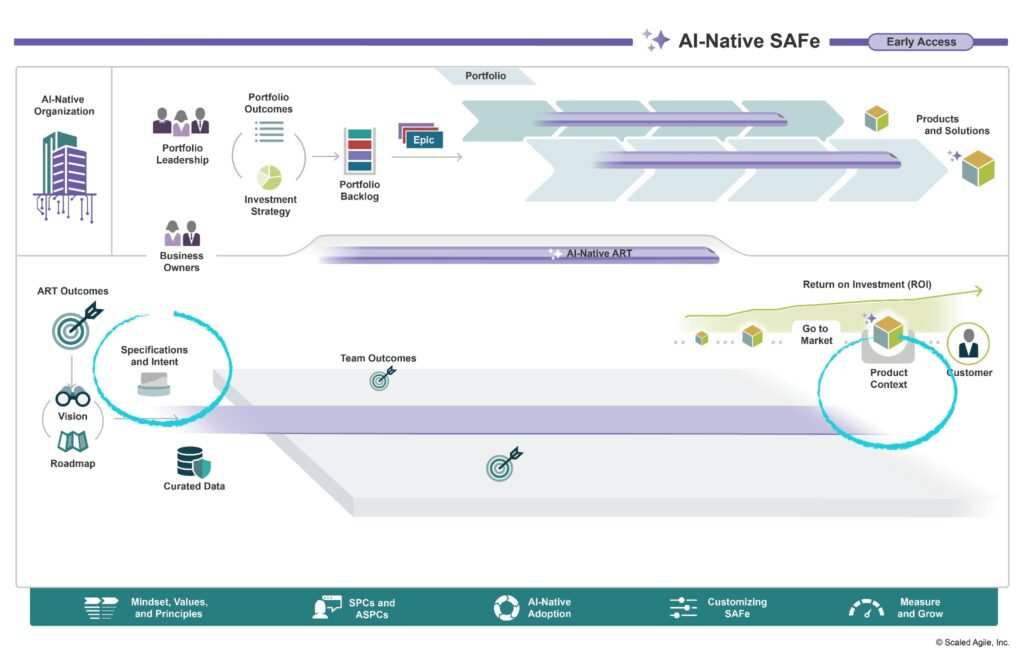
Artificial intelligence has no real common sense or business understanding. If it doesn’t receive the right information, it simply carries out instructions without understanding their purpose or context. That’s why these three elements are needed:
Intent: the why
Intent sets out why we are doing a given piece of work. It makes the goal clear and describes the business outcome we want to achieve.
Product Context: the context
Product Context provides the business and professional background. It helps AI understand the product, the users and the specifics of the organisation, so that it doesn’t suggest generic, boilerplate solutions.
Specification: the how
The Specification describes how the solution should be implemented. It links business needs to technical implementation, defines the technical boundaries and breaks the problem down into smaller, easily verifiable steps.
AI can create genuine value when we tell it not only what to do, but also why, in what business environment and under what conditions it needs to solve the task.

The quality, reliability and coverage of the curated data (Curated Data) available to an organisation directly determine how valuable the results AI can produce are, and which business outcomes it can support.
It’s important that the framework provides guidance in this area and encourages organisations and ARTs to treat improving the quality and manageability of their data as a strategic investment.
II. Cross-Functional, AI-Augmented Teams
In AI-Native SAFe®, teams are smaller and more flexible. The emphasis is no longer on traditional roles, but on the team having the capabilities needed for product knowledge, domain expertise and delivery.
In many organisations, this change has already begun. The teams of up to 10 people that used to be typical are increasingly being replaced by AI-augmented teams of 3-7 people. These teams are smaller and respond to change faster. They don’t necessarily follow Scrum or Kanban strictly; instead, they shape the ways of working that best support flow in their own environment.
The Emphasis Is on Capabilities, Not Roles
In the age of AI, team roles are still evolving. New titles appear almost daily, such as Product Engineer, Product Architect or AI Product Manager. That’s precisely why AI-Native SAFe® places less emphasis on specific roles and far more on the capabilities required. AI-Native SAFe® describes the team through four capabilities: product, domain expertise, building (builder) and AI itself. Below we look at the first three, the human capabilities.
1. Product Capability
The team needs people who deeply understand the product, the business goals and customers’ needs.
2. Domain Expertise
The team needs specialists with deep business or professional knowledge in the given field. For example, clinicians in healthcare, financial experts in financial organisations, lawyers in legal settings. They ensure that AI-supported solutions genuinely meet the requirements of the domain.
3. Builders
It’s not only software developers who are needed, but anyone who can use AI to create, develop or deliver the work entrusted to them.
Today, a builder can be a developer, business analyst, project manager, tester or even a business expert; what matters is that they can create value using AI.
The question of capabilities has always featured strongly in agile teams. We have talked about cross-functionality, the essence of which has always been that the team has every competency needed to deliver value, doesn’t operate in functional silos, and that knowledge is ideally not concentrated in a single person.
So the novelty will be the strengthening and evolution of this mindset in light of the three human capabilities above. Rather than checking whether a team has development, testing, UX, business analysis, DevOps and so on, we will look at whether the team has Product capability, Domain expertise and Builder capability.
A genuinely new element in the SAFe® Big Picture, however, is the AI Value Architect role, which embodies a new capability package.
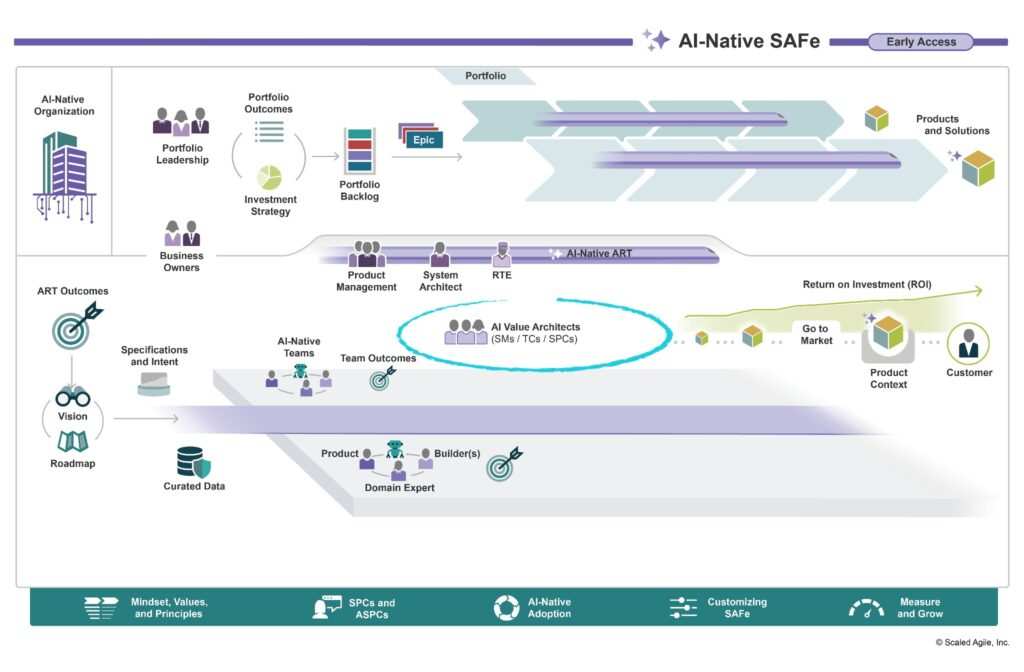
Its purpose is to ensure that:
- AI doesn’t appear in the organisation for its own sake, but creates genuine, measurable business value. To do this, it connects business goals, technological opportunities and people’s development.
- It continuously looks for opportunities where AI can create new value, and supports the organisation in responsibly designing AI-supported workflows and products.
- It also plays an important part in promoting the wider use of AI across the organisation, and the continuous development of AI knowledge and AI fluency.
Who Can Be AI Value Architects?
According to AI-Native SAFe®, professionals who already support organisational change today can bring particularly high value to this role, such as Scrum Masters, Team Coaches, Product Managers, Architects and other agile leaders and coaches. They already have the capabilities this role requires, for example systems thinking, leading change, the ability to connect business and technology perspectives, and a coaching and development mindset with which they help the organisation and its people grow.
III. Iterative Learning and Rapid Experimentation Cycles
Iterative development remains one of the core principles of SAFe®. Indeed, because of the way AI works, continuous learning, review and correction become even more important. However, since the results AI produces are not fully predictable, solutions need to be validated continuously against business goals and user needs.
This area will bring new practices that fundamentally change our day-to-day work, along with a strong new mindset to embed. In relation to Scrum, Jeff Sutherland also stresses that the arrival of AI calls for a new infrastructure of trust, and that this trust comes from repeatedly confirming that the system really does what it promises.
How Does This Fit into Everyday Work?
In AI-Native SAFe®, the emphasis is on rapid experimentation, continuous customer validation and data-driven learning, so that AI developments stay closely tied to real business outcomes throughout.
Iterations and PIs
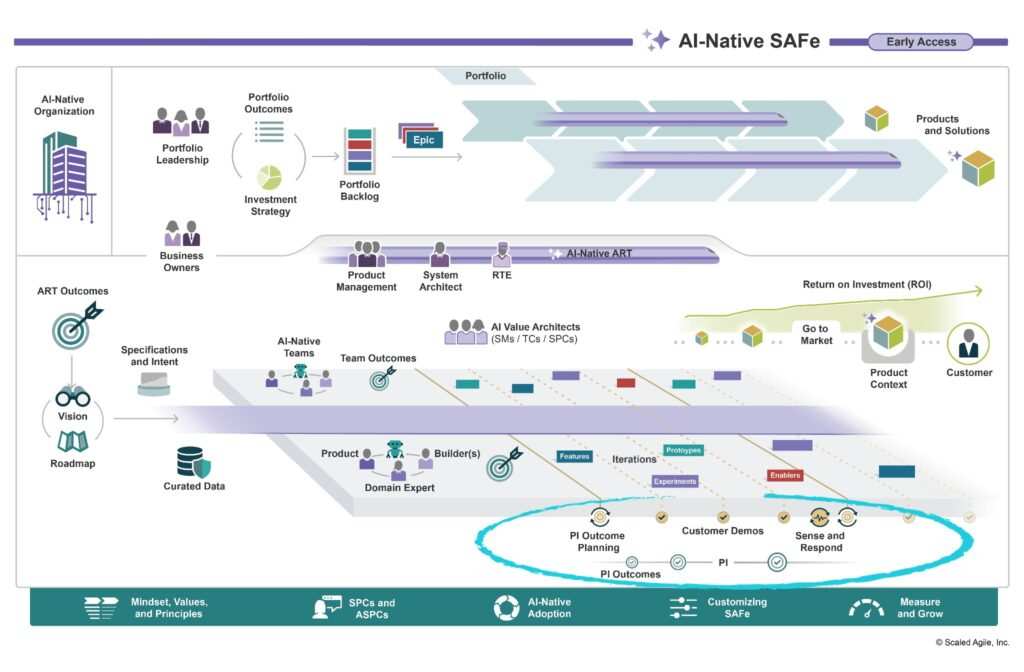
For now, the cadences (typically two-week iterations and 8-12 week PIs) remain essentially unchanged, although many expect AI to shorten iteration cycles significantly. The events, however, are being reshaped: the two-day PI Planning becomes a one-day PI Outcome Planning, and learning cycles become more frequent because Sense and Respond takes place every iteration.
The emphasis is no longer on building as much functionality as possible over a longer period, but on learning, measuring and adapting as quickly as possible.
New (or renamed) events and event elements are also being built into the system:
| Lean-Agile SAFe® | AI-Native SAFe® | New emphasis |
|---|---|---|
| PI Planning (2 days) | PI Outcome Planning (1 day) | The focus is not on planning tasks, but on the business outcomes to be achieved, customer value and measuring success. |
| Inspect & Adapt and System Demo | Sense & Respond | Instead of a single half-day event per PI, a two-hour event every iteration that also incorporates System Demo activities. We respond faster to changes in the product environment, in AI models and in customer needs, deliberately stop experiments that aren’t delivering results, and learn at ART level. |
| (new element) | Customer Demo | We regularly check directly with customers whether the solution is desirable and works in real-world use. |
Agilists may smile and sigh: this is what we should have been doing all along. Even so, with the help of AI, the emphasis may finally shift towards the value-centred thinking that many have so far sacrificed for churning out tasks and for a sense of busyness that keeps everyone satisfied.
IV. Scaled Development and Innovation
AI-Native SAFe® evolves the Continuous Delivery Pipeline with a broader concept: the Continuous Innovation and Delivery Pipeline supports not only the development and delivery process, but the entire innovation lifecycle. With this new name, it in fact reinforces the process that Product Managers and Product Owners have always worked on to create innovative, marketable solutions: problem identification, ideation, experimentation and validation.
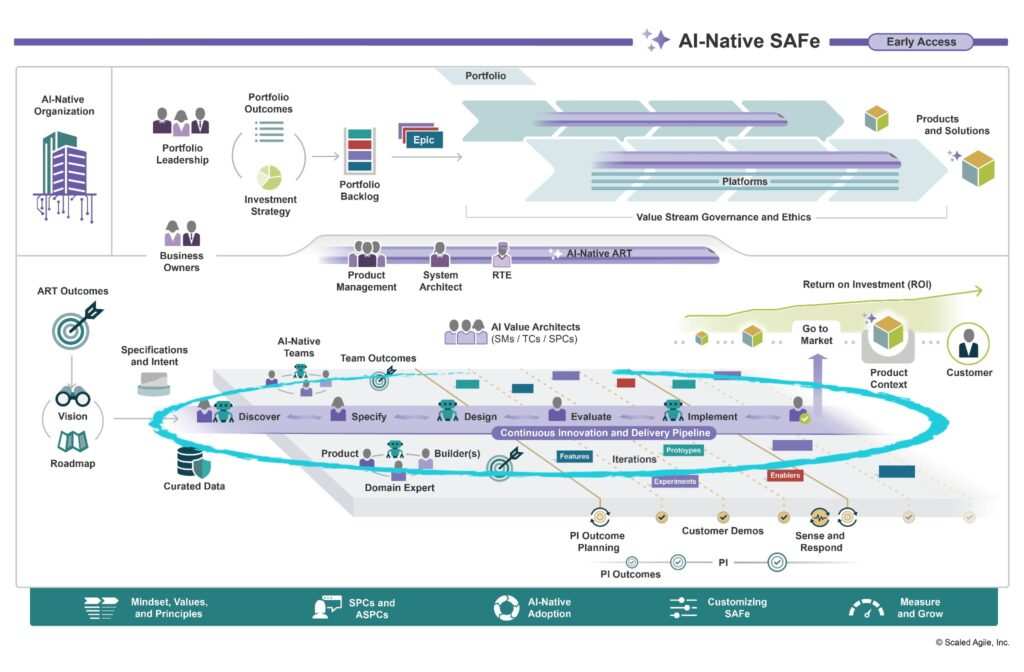
What is genuinely new is that the Continuous Innovation and Delivery Pipeline (CIDP) is built on an AI-first workflow. This means processes are designed from the outset so that people and AI agents work together. The workflow deliberately manages the handoffs where tasks pass from a person to an AI agent, from an AI agent to a person, or between AI agents. The new CIDP guidance will help organisations establish both the technical foundations of AI-supported work and the operating processes it requires.
New elements may appear in development planning, such as prototypes or experiments. In addition, AI makes it much easier to apply Set-Based Design.
Set-Based Design is not a new concept. One of the principles of Lean Product Development also stresses that uncertainty should be reduced through learning rather than early decisions. AI makes this approach much cheaper and faster: whereas developing several alternatives used to require significant resources, AI can now produce several proposed solutions, prototypes or even working implementations in minutes. As a result, Set-Based Design can become everyday practice in the age of AI far more than before. The goal, then, is no longer to choose the first working solution as early as possible, but to explore several viable alternatives quickly and, on that basis, choose the one that creates the most value.
Finally
SAFe® is therefore presenting the innovations introduced in response to AI in a series of presentations, available here. It stresses that Core SAFe® is not disappearing, and AI-Native SAFe® does not replace it. Quite the opposite: the agile framework continues to provide the foundation for organisations. AI-Native SAFe® appears alongside Core SAFe®, offering guidance to organisations that want to introduce AI.
SAFe and Scaled Agile Framework are registered trademarks of Scaled Agile, Inc.
Need some help?
If you’d like to prepare for the changes AI is bringing, explore our AI role-based training courses, or request a free consultation on introducing and using AI.
