
Using ChatGPT: A complete guide to the practical application of artificial intelligence
The use of ChatGPT is becoming more widespread today, as artificial intelligence has fundamentally transformed the way we work, learn, create and operate. Whether it's content creation, programming, language learning, thesis writing or even business analysis and market research, the use of ChatGPT AI offers huge benefits to individuals and organisations alike. In this article, we explain how the system works, how it is available in Hungarian, what free and paid versions exist, and give practical examples of how it can support everyday life and business processes.

What is ChatGPT?
ChatGPT is a generative artificial intelligence model developed by OpenAI. It is based on the Generative Pre-trained Transformer (GPT) technology, which can understand natural language and provide human-like responses. The system learns continuously by processing user feedback and large amounts of textual data.
What can ChatGPT be used for?
ChatGPT is highly versatile in everyday life and in professional environments.
Now let's see where you can put it to good use!
1. Content creation and communication
- Writing articles, blog posts, social media posts or newsletters.
- Marketing and advertising copywriting, slogans, product descriptions.
- Drafting e-mails and official letters.
- Transcription or stylistic correction of existing texts.
2. Education and learning
- Simple explanation of complex concepts.
- Preparing learning materials and exercises.
- Language learning support, translations and vocabulary development.
- Using ChatGPT for a thesis: drafting outlines, summarising literature, correcting language.
3. Business and professional application
- Market research, competitor analysis.
- Preparing business plans and marketing strategies.
- Preparing presentations, speeches and reports.
- Time management and task list compilation.
4. Programming and technical tasks
- Writing code snippets and fixing bugs.
- Explaining algorithms and frameworks.
- Preparation of documentation and simplification of technical texts.
5. Daily life and leisure
- Recipe suggestions and cooking tips.
- Suggestions for trip planning, attractions and cost estimates.
- Creative ideas for organising events (e.g. birthday parties, family gatherings).
- Find gift ideas and creative solutions.
6. Creative use
- Writing short stories, poems, stories.
- Create video and podcast scripts.
- Inspiration for games, projects or campaigns.

Using ChatGPT artificial intelligence step by step
Although ChatGPT may seem very simple at first, it is worth taking a closer look at how it works to make the most of all its features.
1. Registration and login
To access ChatGPT, you must first create a free account on the OpenAI official site or in the mobile app. You can sign in with an email address, Google or Microsoft account.
2. Choose a subscription
ChatGPT is available in different packages, so everyone can find the one that suits their needs:
- Free version: access to basic functions, with limited daily use
- ChatGPT Plus: faster response times, higher capacity and priority access to more advanced models
- ChatGPT Pro: use the latest AI models for complex analytics and business-level tasks
- Business: customizable features, extended data management and security options for companies, tools for teams such as projects and custom GPTs
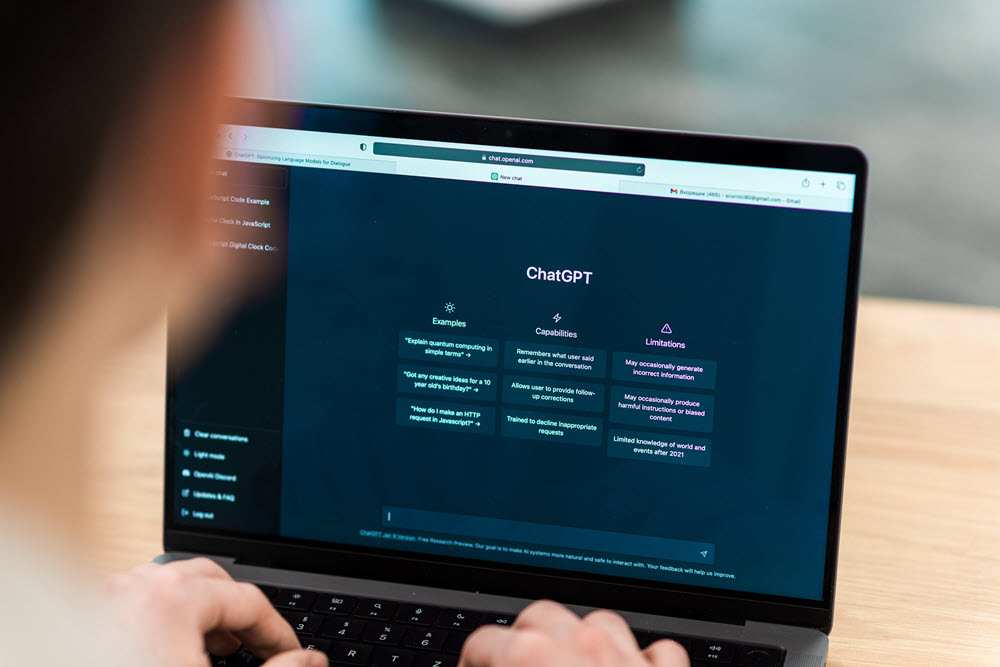
3. Overview of the interface
- Menu on the left: manage previous chats and start new chats
- Settings: the possibility of customisation, for example to enable communication style or special features (image generation, sound input)
- Central input field: enter the request here, i.e. the prompt
4. Prompting
The key to how ChatGPT works is a well-defined request. It can be short ("Write a recipe for pasta!") or detailed ("Write a 500-word blog article on digital marketing trends, with subheadings and an introduction").
5. Try out advanced features
- Use ChatGPT in English: the system can communicate in natural Hungarian
- File and image upload: the possibility to analyse documents or images
- Browse function: access to up-to-date online data available on certain subscriptions
- Voice mode: you can even chat live on your mobile phone with the chatbot
6. Managing responses
The resulting answers can be copied, regenerated or even refined with additional instructions. The user can also provide feedback to help improve the system.
Tips for using ChatGPT
ChatGPT will be truly effective if it is used in a conscious and thoughtful way.
Let's look at some useful tips to help you do this!
- Formulate precise instructions: The more detailed and clear the prompt, the more relevant and valuable the answer.
- Trying out functions individually: It's worth testing each of the options - such as voice input, image analysis or browsing - first to get a better idea of what the device can do.
- Combining options: By combining functions (e.g. browsing + image uploading), more detailed and comprehensive answers can be obtained.
- A creative approach: ChatGPT can not only be used to create text, but also to generate photos or even use them for analysis, which opens up new perspectives in its use.
- Keeping data security in mind: Documents and images uploaded to the system will be processed, so sharing sensitive or confidential information is not recommended. For business data, it is always advisable to check the privacy policy of the platform.
- Iterative use: If a response does not fully meet expectations, it is worth clarifying the prompt or giving a new instruction. Small tweaks can often improve the result significantly.
What are the benefits of using ChatGPT?
The benefits of ChatGPT are manifold, and are constantly expanding as the technology evolves.
Now let's look at why AI can be useful.
- Saving time: Routine, repetitive tasks can be performed faster by automating them, so human resources can be allocated to more strategic, higher-level tasks.
- Cost-effectiveness: Using automated solutions can reduce recruitment and training costs.
- Improving content quality: It can be used to fine-tune the language, style and logic of texts; it can also support you in idea generation and editing.
- Knowledge transfer and education: It can be used to make complex topics easier to understand, for individual or group practice and to produce teaching aids.
- Fast response: Reduce waiting times for both customer and internal communications with immediate responses.
- Continuous availability: The service is available 0-24 hours a day to support operation across time zones.
- Multilingual operation: The ability to communicate and translate in several languages is particularly useful when you have a global presence.
- Personalised answers: Tailored responses and suggestions can be provided based on previous interactions.
- Scalability: It can serve a large number of concurrent users, making it efficient for high-traffic applications.
- Natural language processing: It understands and creates human-like language formulations, making it suitable for content generation and explanations.
- Accessibility for people with disabilities: Text-based interactions can support barrier-free access and communication.
- Workflow support: It helps in decision preparation, drafting and simplifying repetitive administrative tasks.
What are the limitations of using ChatGPT?
Although ChatGPT can be used for a wide range of tasks, it has its shortcomings in certain situations.
- Limited interpretation of linguistic nuances: The full complexity of human language cannot be understood, so answers can sometimes be superficial.
- Mechanical text style: It has a tendency to repeat certain phrases, so the content generated often requires post-editing.
- Lack of references to sources: Although it can summarise texts, it often does not provide accurate citation or detailed analysis.
- Lack of recognition of sarcasm and irony: He or she is not sensitive to subtle forms of humour and language games, and may misinterpret certain statements.
- Inflexibility when changing questions: After answering a question, you may find it difficult to move the conversation in a different direction.
What ethical issues does the use of ChatGPT raise?
Ethical challenges are certainly worth mentioning in the context of ChatGPT. These include the potential for misuse, data security, bias in the data being used, and the impact on education and the world of work.
Plagiarism and abuse
One of the biggest risks is that ChatGPT produces human-like text, which can be used to defraud, plagiarise or spread misleading content. In education, for example, there may be concerns about students using the system to write essays and professional papers. A similar problem arises when someone uses AI to mimic another person's style and thus communicate with misleading intent.
Cybersecurity risks
ChatGPT can generate code — which may be abused by hackers to create malware or phishing tools. Although OpenAI includes safety mechanisms, these can’t always prevent misuse.
Data Bias
The functioning of the model depends to a large extent on the data used during training. If biases or one-sided information are included, they may also appear in the generated texts. For this reason, it is important to continuously monitor the training data and to include as wide and diverse a range of sources as possible.
Labour market impacts
As a result of automation, ChatGPT can partially replace certain tasks, such as data entry, customer service or translation. This may raise concerns about the future of jobs. At the same time, AI not only replaces but also creates new opportunities: it can support professionals in their daily tasks and contribute to the emergence of new types of jobs.
Data protection and privacy
ChatGPT works on the basis of user input, so in theory it may handle sensitive or personal information. The storage and processing of data raises data protection issues, in particular with regard to the regulations in force in the European Union. As an example, in 2023, the Italian data protection authority temporarily suspended the service because it considered it to be non-compliant with the GDPR. The ban was only lifted when OpenAI incorporated additional data protection safeguards.
What other options are there besides ChatGPT?
In addition to ChatGPT, there are dozens of alternatives available - some optimised for content creation, others for coding. The choice depends on the exact needs of the user.
- Google Gemini (formerly Bard): Google launched its own AI chatbot in 2023, called Bard, and continued development a year later as Gemini. It has the advantage of being directly linked to the search engine, so it can display the most up-to-date data. However, it has been controversial in several cases because some of its answers have proved inaccurate.
- Microsoft Copilot: Microsoft has made a significant investment to strengthen its partnership with OpenAI, bringing GPT-based chat to Bing search. Copilot not only displays search results, but also complements them with AI-generated answers to provide more complex information.
- Content-focused tools: In recent years, a number of other solutions have become available, such as AI-Writer, Article Forge, ChatSonic, Jasper, DeepL Write, Perplexity AI or Rytr, which specialise in different content production needs.
- Developer tools: AI models that support programming are also becoming more widespread. These include AlphaCode, GitHub Copilot, Amazon CodeWhisperer and Tabnine, which help you create code snippets, debug code and improve your development workflow.
Frequently asked questions about ChatGPT
How do I use ChatGPT in Hungarian?
The first question most users ask is how well ChatGPT works in English. The good news is that, thanks to the continuous improvements made by OpenAI, ChatGPT is now available in English with high quality. The system is able to produce coherent, creative and correct texts in Hungarian, whether it's writing articles, translating, brainstorming or answering questions.
Is ChatGPT free to use in Hungarian?
ChatGPT is also free to use: all you need is a registered account on the OpenAI platform.
The free version also includes ChatGPT 5, with limited capacity and a daily usage limit. This means that basic users also have access to the latest model, which is significantly more accurate and faster than the previous versions 3.5 and 4.
What questions can I ask ChatGPT?
Virtually any question can be asked on ChatGPT: simple, everyday questions (such as "What's the weather like in Budapest?"), complex science problems, creative writing prompts, programming exercises or even thesis-related topics.
How accurate is ChatGPT?
ChatGPT is an advanced language model that provides highly accurate and relevant answers in most cases. However, there may be errors, misinterpretations or inaccurate data, so it is always a good idea to check the generated content before making professional or critical decisions.
Ready to Unlock Real Business Value with AI?
Effective implementation of ChatGPT and other AI solutions will not only result in faster and more accurate work, but also provide a competitive advantage in the long term. Our consultants can help you develop your company's AI strategy, choose the right technology and operate it safely.
Contact us for a free consultation, and let's develop a successful AI strategy for your organisation together!
