
Written by: Zsolt Czimbalmos, PMP, PBA, ACP, DASSM
What will be the leadership challenges in 2026?
The old answers no longer work
At ProMan Consulting, we begin each year by consciously reviewing the past and setting strategic priorities for the period ahead. As every year, our team held a two-day retreat: we analysed our experiences over the past period and jointly defined OKRs and strategic focus areas for the coming year.
We are not claiming to have all the answers. However, from working with leaders, organisations and teams, we see very similar patterns over and over again. This article — primarily aimed at organisational and business leaders — outlines what we consider the key leadership challenges in 2026. It is not intended for leaders who seek excuses, quick fixes, or tools without reflecting on their own operations, or for those who believe that the root of problems lies solely in people or teams.
We are convinced that recognising and consciously addressing the following challenges has perhaps never been more urgent than in today’s economic and technological environment.
Change is no longer a temporary state, but a permanent operating condition.
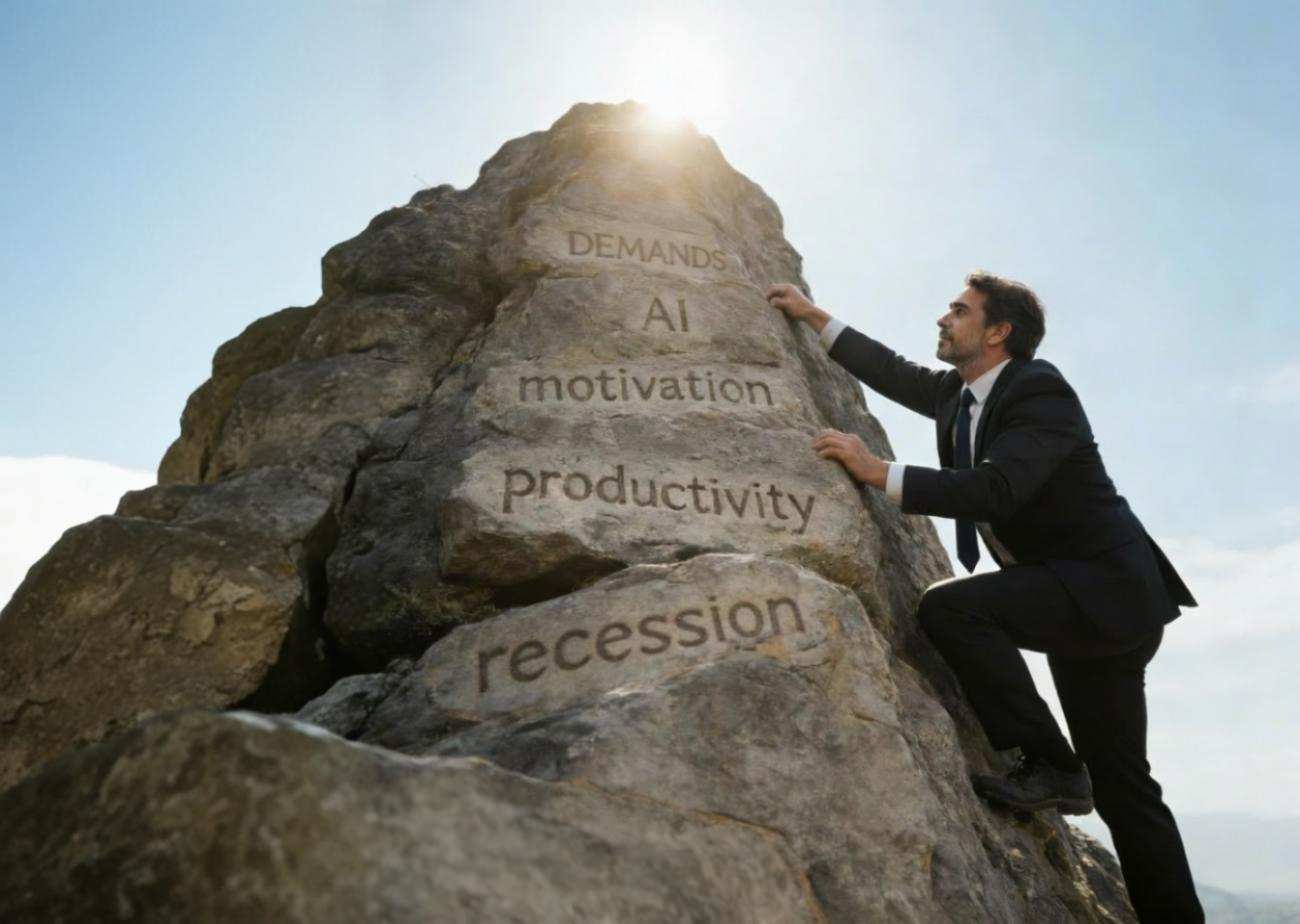
When one thing is certain: change
In recent years, leaders have become accustomed to change being part of everyday operations. By 2026, however, it becomes clear that we are no longer talking about temporary adaptation, but about a new operating norm. Economic uncertainty has become persistent, technology — especially AI — has permeated every area of business, growth can no longer be taken for granted, while organisations are simultaneously under pressure to increase both the speed and the quality of decision-making.
In this environment, the leadership role does not narrow — it becomes more complex. The key question is no longer which tools we use, but which principles guide the way we lead.
1. A Challenging Economic Environment: When Efficiency Is Not an Option, but a Prerequisite
By 2026, fewer and fewer organisations will be able to afford masking operational issues through growth. The focus inevitably shifts toward process efficiency, shorter lead times, and tighter cost control.
In this context, AI and automation are often portrayed as a magic bullet — wrongly so.
The real leadership challenge is not selecting technology, but designing an AI and process improvement strategy. By 2026, AI is expected to no longer be a standalone solution, but a core capability embedded in virtually all business software. Competitive advantage will not stem from whether AI is used, but from how it is used:
- which processes it is consciously applied to,
- what data it operates on, and
- which business objectives it ultimately serves.
As a result, process optimisation ceases to be an IT project and becomes a leadership responsibility.
Key Focus Areas When Designing an Organisational AI Strategy:
- AI vision aligned to business objectives Which business decisions, processes, or risks do we want to manage more effectively with AI?
- AI governance and decision-making framework - Who decides on AI adoption and usage? Which decisions should not be delegated to AI? What are the responsibilities, accountabilities, and decision rights?
- Data strategy What data is available, where is it accessed, which data is critical or sensitive, what data must not be shared with external AI solutions, and how can continuously improving data quality be ensured?
- IT security Proportionate protection to minimise incidents arising from AI usage. What is permitted for employees? How do we handle shadow AI (when employees independently start using AI tools)? How do we ensure secure yet innovative operations?
- Process prioritisation and AI portfolio - Not all processes have the same level of AI maturity. Which initiatives qualify as quick wins? Which development directions are business-critical, and where is experimentation still required?
- Operating model and agility - AI is no longer a project but a continuous capability. Rapid technological progress elevates the importance of MVP thinking and fast user feedback. Decision rights often need to be placed closer to those operating at the intersection of business, IT, and data, requiring close, day-to-day collaboration.
- Competence and leadership development – Stakeholders must understand AI’s potential, how to use it effectively, its limitations, and the level of trust that can be placed in AI-generated outcomes.
- Change management and communication - AI adoption can easily encounter resistance. It is essential to communicate AI’s organisational role and its impact on individual work — explicitly clarifying what AI will and will not replace.
- Metrics, OKR and learning mechanism Because the technology itself evolves continuously, an AI strategy must function as a learning system rather than a static document. Concrete development actions and roadmaps should be tied to defined metrics — or even more importantly, to key results. This ensures that the AI strategy answers the what and why, while OKRs serve as a structured learning mechanism to understand how and how well the solution works.
+1 Ethics - Providing guidance for leaders when AI is technically capable of doing something, but its use is questionable from a business or human perspective.
AI adoption also has an additional leadership dimension: many leaders are wary of AI solutions. This reluctance often stems from the fact that AI makes leadership shortcomings more transparent, exposing decision-making that is hierarchical rather than well-considered or professionally grounded. This, however, is a false narrative that does not need to be sustained. With appropriate task delegation and clarity of roles, AI can actually strengthen the leadership role while simultaneously reinforcing professional expertise and decision quality.
This brings us directly to the next point:

2. Agile Operations: Speed of Delivery as a Survival Factor
In an environment of high volatility, long planning cycles become a business risk by 2026. Markets react faster than traditional decision-making structures are able to operate.
When every important decision ends up with leaders, the organisation is not slow — leaders become the bottleneck. This unhealthy dependency can lead to leadership burnout, not because of excessive workload, but because leaders retain too many decisions themselves. Leadership overload is not a time-management issue; it is a decision-quality risk. Beyond a certain point, the solution is not more information, but fewer decisions.
In this context, agility is not a methodology, but a leadership mindset:
- smaller decisions, made faster and as close to the work as possible,
- shorter feedback loops,
- “good enough” solutions designed for learning (MVP).
The greatest barrier is often not the organisation, but the leader — specifically, the internal need for every decision to be perfectly justified. In 2026, fast learning will be more valuable than flawless planning.
Over the past years, many organisations have attempted agile transformations. Some have succeeded, others achieved partial results and have since drifted back toward more traditional operating structures.
Based on our experience, agility at the workflow level will typically emerge in mixed-portfolio environments. However, when it comes to organisational culture and leadership mindset, we believe that only agile principles can provide viable answers to the challenges of 2026.
3. IT security as business risk management
In many organisations, IT security is still treated as a technical issue. In reality, however, it represents business risks: data loss, operational disruption, and reputational damage. IT security becomes “just” a technical issue when leaders avoid taking a clear position on business risks.
IT security turns into a real risk where it is not explicitly defined who is allowed to take which business risks. In many organisations, policies are used as a substitute for leadership decisions. This does not reduce risk — it merely conceals it. The challenge is to avoid being under-protected, while also ensuring that security does not become an operational barrier.
The leader’s role here is to define the right balance: which risks are unacceptable, and which risks the organisation is consciously willing to take.
IT security should be designed in line with the organisation’s size, operating environment, and risk profile. The use of AI, for example, does not inherently increase IT security risk — unregulated use without leadership guidance does.
The phenomenon of shadow AI is not a technological problem, but a signal that the organisation wants to learn faster than leadership decisions are being made.
IT security does not fail when an incident occurs; it fails when leaders do not clearly state which risks they are willing to take — and why.
4. Hybrid operation and performance: new benchmarks are needed
By 2026, hybrid work will be a stable and established mode of operation, yet in many organisations performance measurement still relies on presence rather than outcomes. Over time, this leads to underperformance and burnout.
The real questions are:
- what we define as value creation,
- how progress can be measured without excessive control, and
- how much autonomy teams are given.
By 2026, OKR-based joint planning, high-quality interactions between leaders and their teams, and the clear communication of organisational strategy will play an even more critical role.
It is important to recognise that an excessive number of initiatives or projects is not a sign of ambition, but often of a lack of focus — which weakens the performance of both teams and individuals.
Beyond performance measurement, the use of effective feedback loops is essential. Their absence is not only a cultural issue, but also a loss of information that undermines organisational learning.
5. Leadership Development: The Highest-Return Investment in 2026
While technology is evolving at an explosive pace, a significant proportion of leaders are still trying to respond with the same mindset they applied five or even ten years ago.
By 2026, leadership development is no longer a “soft” topic, but:
- a decision-quality issue,
- a factor of operational resilience, and
- a source of long-term competitive advantage.
The focus is not on learning new tools, but on developing core competencies such as:
- decision-making under uncertainty,
- systems thinking,
- strengthening middle management and effective delegation, and
- managing the intersection of technology, business, and people.
In practice, many organisations exhibit a difficult-to-articulate triad: overload, lack of meaningful feedback, and lack of direction. People work hard, yet it is unclear what truly constitutes success. Leaders are busy, yet meaningful feedback is scarce, as day-to-day operational pressure overrides almost everything else.
In such an environment, motivation does not run out — it simply cannot take shape, because there are no reference points that make performance and effort interpretable. By 2026, this is no longer merely a cultural issue, but a business risk: sustained overload, the absence of feedback, and blurred strategic direction directly degrade decision quality and organisational adaptability.
The issues described above are typically systemic failures, the result of a coherent — yet outdated — leadership operating model that has gradually solidified over recent years or even decades. These models are usually characterised by the following patterns:
- the leader knows everything (or at least appears to),
- decisions are centralised,
- communication is one-way,
- mistakes are attributed to individuals rather than systems and must always have someone to blame,
- overload is considered a normal state.
These patterns can be weakened at both organisational and individual levels; however, soft-skill development alone addresses only the tip of the iceberg. Increasingly, the leadership narrative of “I don’t know, but let’s learn it together” is gaining ground. Rather than confidence, the ability to manage honest uncertainty is becoming a leadership virtue. Handled and applied well, this shift can reshape both organisational dynamics and individual leadership behaviour.
Closing Thought: The Leadership Role Is Not Shrinking — It Is Being Revalued
In 2026, the leadership challenge is not to keep pace with technology, but to provide direction in an environment of constant change. provide direction in an ever-changing environment.
Without clear decision principles, consistent focus, genuine feedback, and a learning-capable operating model, neither AI, nor agility, nor any new tool will create real value.
The leadership role has not become easier — it has become more significant and more complex. Organisations that remain viable will be those where leaders are willing to examine their own ways of working and consciously develop them.
At ProMan Consulting, this is how we support leaders and organisations:
we do not develop tools — we develop mindsets and operating frameworks. mindset and operational framework we develop.
If several of the challenges raised in this article resonate with you, it may be worth continuing the conversation — feel free to reach out to us with confidence. While we do not claim to possess a “philosopher’s stone,” we believe that through joint work — as in previous years — workable answers to future challenges can be found.
