AI Image Generator Guide: How It Works, Uses, and the Best Tools in 2026
The AI image generator is one of the fastest-evolving generative AI technologies. With its help, new images, illustrations, or graphic content can be created within seconds from text prompts—or even from an existing photo. More and more companies are using it for marketing content creation, advertising materials, product image generation, design prototyping, and even for educational and presentation purposes.
Modern systems are capable of producing photorealistic images, illustrations, and complex graphic styles. In addition, the “image-to-image” feature of AI image generators is becoming increasingly widespread, allowing an existing image to be transformed into a new style or context. In this article, we explore how online AI image generators work and which tools are currently considered the most popular.
What is an AI Image Generator?
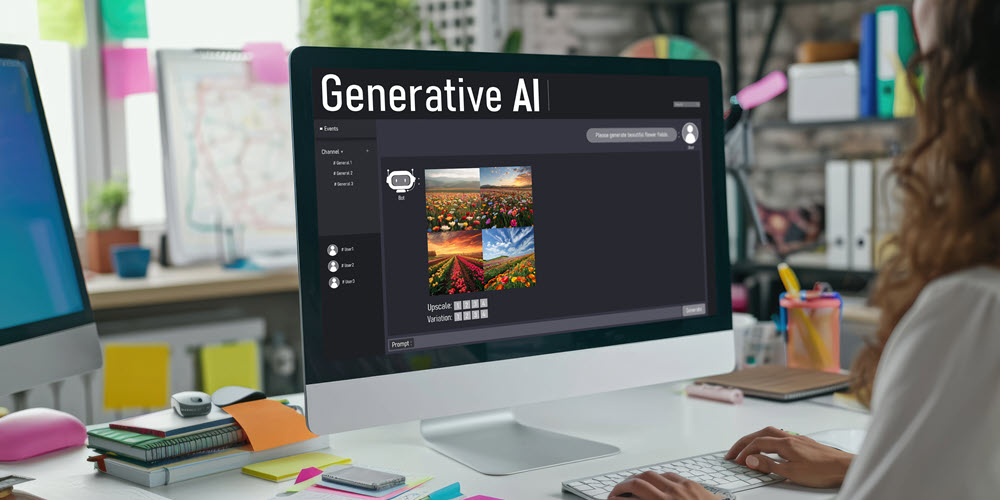
An AI image generator is a system based on artificial intelligence that can create images from textual instructions—so-called prompts. These models are trained on massive amounts of image and text data, enabling them to recognize different visual styles, objects, and the relationships between them.
Most modern AI image generators are available through online interfaces, meaning they can be used directly from a browser without installing any software.
How does an AI image generator work?
1. Interpreting the Text (Prompt)
The first step is that the user provides a textual description, which may include objects, styles, mood, or environment.
Example prompt:
“robot working in a modern glass office, futuristic style, natural lighting”
The AI model analyses the elements in the text and determines:
- which objects should appear
- what style the image should have
- what composition and mood to apply
2. Using learned patterns
AI image generators are trained on millions or even billions of images and text descriptions, allowing them to learn:
- the shape and structure of objects
- what a given style looks like
- the relationship between text and visuals
As a result, the AI can generate entirely new images that have never existed before.
3. Image Generation with Diffusion Models
Most modern AI image generators use diffusion models.
In simplified terms, the process works like this:
- The system starts from a random noise image
- It gradually “cleans” the image step by step
- At each step, the model takes the prompt into account
- The noise eventually turns into a detailed image
This process usually takes only a few seconds.
4. Image Refinement and Variations
Most AI image generators create multiple versions from the same prompt. The user can then:
- modify the prompt
- request new variations
- refine details
- generate a higher-resolution version
5. Generating from your own image
Many modern systems also support the “image-to-image” feature.
In this case, the user uploads an image, and the AI can:
- transform it into a different style
- modify the background
- create a new composition based on it
What Can an AI Image Generator Be Used For?
It can be applied across many fields, as it enables fast and efficient creation of visual content.
Marketing and online content creation
This is one of the most common use cases. Unique visuals can be created quickly—tasks that previously required graphic design work:
- blog post illustrations
- social media content
- advertising creatives
- website graphics
Graphic design and creative projects
In the design field, AI image generators help visualize ideas and develop creative concepts. For example:
- creating illustrations
- visualising concept designs
- character and environment design
- digital art
Websites and digital content
When building websites, unique visual elements are often needed. AI makes it easy to create:
- hero images
- illustrations
- background images
- presentation graphics
This is especially useful for startups and small businesses.
Product and Advertising Image Generation
In e-commerce, AI image generators enable:
- creating product images in different environments
- generating visuals for advertising campaigns
- rapid creative testing
This allows marketing teams to test multiple creative variations in a short time.
What to Consider When Choosing an AI Image Generator
It’s not just about which tool creates the most visually impressive images.
Key factors include:
- image quality
- accuracy in interpreting prompts
- editing capabilities
- whether the tool can be used for commercial purposes
It’s also worth considering whether the tool supports image-to-image generation, how well it integrates into daily workflows, and how effectively it handles Hungarian-language prompts. In the long run, pricing, licensing, and usage rights will also determine the best choice.
Free or Paid AI Image Generator?
Free AI image generators can be a good option for developing creative concepts and handling general image generation tasks.
However, if higher image quality, commercial usage, faster workflows, or large-scale generation are important, a paid tool is usually the better long-term choice. In a business environment, reliability and consistent quality tend to matter more than whether the tool is free.
What are the limitations of AI image generators?
Although AI image generators can produce impressive results, they do not always deliver perfect outcomes. Interpreting complex prompts, achieving precision in fine details, and maintaining brand-consistent visual coherence can still be challenging. It is also important to consider usage rights, and in many cases, generated images require post-editing.
What Licenses Apply to AI-Generated Images?
Usage rights for generated images vary by platform. While many tools allow free use of generated images, the exact licensing terms always depend on the provider and the subscription plan.
Some platforms allow full commercial use, while others may impose restrictions—for example, on branded content, advertising campaigns, or resale. Free AI image generators often come with stricter limitations compared to paid versions.
It is also worth noting that some systems may use generated images to further train their models, and in certain cases, images may appear in public galleries.
Before using AI-generated images for business or marketing purposes, it is recommended to check:
- whether commercial use is allowed
- copyright terms
- data handling policies
- ownership of generated content
Proper licensing is especially important for advertising campaigns, brand materials, and large-scale content production.
Best AI Image Generators in 2026
Several advanced AI image generators are available on the market. Below are some of the most notable solutions in terms of image quality, usability, and business applicability.
Midjourney AI image generator
Midjourney excels at creating highly aesthetic, detailed, and visually striking images, making it especially popular in the creative industry. It is ideal for design concepts, illustrations, and campaign visuals. It performs particularly well when artistic, cinematic, or stylized imagery is required, often delivering stronger visual impact than average tools. A top choice for branding, inspiration, and premium-quality creatives.
ChatGPT Images
ChatGPT Images follows textual instructions with high precision, making it especially useful when images need to be both visually appealing and accurately controlled. It not only generates new images but also supports editing, refining, and transforming existing visuals. This makes it an efficient tool for marketing materials, illustrations, and creative concept development—all within a single interface.
Adobe Firefly
Adobe Firefly is a reliable option in both business and creative environments, particularly when brand-consistent visual content is important. Its strong integration with the Adobe ecosystem makes it ideal for marketing, design, and content production workflows. It is widely used for campaign materials, creative variations, and professional visual assets.
Leonardo AI
Leonardo AI offers fast and detailed image generation across various styles. It is well-suited for marketing, creative teams, and collaborative environments. It is particularly useful when producing large volumes of visual content while maintaining quality and diversity, making it popular for campaign creatives, concept art, and scalable content production.
Best Free AI Image Generators in 2026
For those looking to explore the technology cost-effectively, several free platforms provide quick and easy entry into AI image generation.
Bing AI image generator (Microsoft Copilot Designer)
Microsoft’s AI image generator is one of the most widely known free solutions. It enables quick and simple image creation directly from the browser. Its ease of use makes it ideal for beginners and casual users, and many people use it as their first AI image generator.
Goolge Gemini
Gemini stands out for its ability to interpret detailed prompts effectively. As part of Google’s AI ecosystem, it supports fast, browser-based image generation. It is particularly useful for easy access, creative brainstorming, and general-purpose image creation.
Stable Diffusion
Stable Diffusion offers a more open and customisable approach. It is popular among developers, advanced users, and AI professionals. Its flexibility and compatibility with various workflows make it a strong choice for those who need technical control, fine-tuning, and scalable usage.
Ideogram
Ideogram is particularly strong at handling text within images, making it highly useful for marketing, advertising, and design tasks. It is ideal for creating posters, social media visuals, and typography-focused creatives where both aesthetics and text accuracy matter.
Best AI Image Generators in Hungarian (2026)
Several platforms now support Hungarian prompts effectively.
Canva
Canva is a great option for users who prefer a Hungarian-language interface and simple usability. It is especially useful for marketers, entrepreneurs, and content creators, as image generation can be combined with Canva’s editing tools.
ChatGPT Images
One of its key strengths is accurately understanding Hungarian prompts. It is ideal for users who prefer not to work in English. In addition to generating images, it also supports editing and refining visuals, making it suitable for more complex creative workflows.
Goolge Gemini
Gemini also performs well in Hungarian, making it a strong option within the Google ecosystem. It is fast, easy to use, and integrates well with other Google AI services.
Bing AI image generator
The Bing AI image generator is another useful option for non-English speakers. It allows quick and easy image generation in Hungarian directly from the browser, making it suitable for general creative tasks and basic marketing materials.
AI Image Generator FAQ
Many common questions arise when using AI image generators, so the most important points are summarised above.
How Precisely Can You Control an AI Image Generator?
This largely depends on the specific tool and the level of detail in the prompt. The more precisely you define the subject, style, composition, and mood, the closer you can get to the desired result. However, in many cases, multiple iterations and refinements are still required.
What Are the Most Common Errors in AI-Generated Images?
AI image generators may sometimes produce inaccurate details, such as distorted or unnatural hands, incorrect proportions, inconsistent backgrounds, nonsensical small elements. Because of this, some generated images may require post-editing or regeneration.
Can AI Image Generators Be Used for Existing Brand Identity?
Yes, but it typically requires deliberate prompting and multiple iterations. If consistent visual identity is important, it’s worth choosing a tool that supports fine-tuning, image editing, and generating brand-aligned variations.
How Suitable Are AI Image Generators for Social Media Content?
They are highly effective for social media creatives, as they allow you to quickly generate multiple visual variations for the same concept. This is especially beneficial for campaigns, post series, and creative testing.
Are There Free AI Image Generators That Work from Your Own Images?
Yes, several tools offer fully or partially free image-to-image features, such as Microsoft Copilot Designer, Leonardo AI, and Adobe Firefly.
Do You Need to Know English to Use AI Image Generators?
Not necessarily, because several modern AI image generators can already be used with Hungarian prompts. However, some tools may still function more accurately with English instructions, so this can still be an advantage for more complex creative tasks.
Are there free AI Image Generators without registration?
Some simpler tools can be used in a limited way without registration, but most modern AI image generators require account creation to manage generation features and user settings.
What resolution are AI-Generated Images created in?
This depends on the platform and subscription plan. Free versions usually offer lower resolution, while paid plans often provide higher image quality, larger sizes, and additional editing capabilities.
Can AI Image Generators Replace Graphic Designers?
Not entirely. They primarily accelerate creative workflows. They are excellent for ideation, initial visual concepts, and rapid content creation. However, for complex branding, campaign strategy, and high-level visual design, professional expertise and human oversight remain essential.
Would You Like to Learn How Generative AI Can Deliver Real Business Results?
AI-based solutions—from content creation to automation—are increasingly supporting more efficient operations, faster workflows, and stronger digital presence. Our experts can help you identify which AI technologies provide real business value for your organisation and how to implement them securely and strategically.
Contact us for a free consultation, and let’s explore how artificial intelligence can support your company’s processes, communication, and business goals.