
Why start your agile journey with us?
Several international studies have shown that organisational agility can greatly improve organisational performance. According to the Scrum.org and McKinsey 2020 survey and the international results of the State of Agile report 2023, there is a clear correlation between organisational performance and customer satisfaction and the maturity level of an agile organisation.
Agile transformation can fundamentally change the way an organisation works, so such a transformation is not an easy task. There are several paths to becoming an agile organisation. Organisations begin their agile journey from different levels of maturity, but there is one thing that all successful transformations have in common: the former, mainly based on hierarchy and organisational „silos” transform organisational functioning to enable greater transparency, shorter decision cycles and more customer-centric collaboration.
With the help of our experts, organisations can go beyond „doing agile” (using agile tools), to „being agile” (becoming agile in everyday operations).
What happens after contacting us?
Ensuring ongoing leadership support is critical to the success of agile transformations, so we strive to bring our expertise to help transformations from the moment the need arises to the moment the results are realised.
1. Free consultation: understanding needs, goals, options
2. Senior management presentation, setting realistic targets
3. Preparing a high-level roadmap and proposal
4. Contracting
5. Delivering within the agreed scope
Our Featured Experts

Réka Pétercsák

Zsolt Czimbalmos

Csengele Hajdu

Áron Ulicska

Tolga Kombak
Sinan Ökek
Caner Çınar
What does agile mean?
Agility in an organisational context means the operational capability to learn quickly, to continuously adjust direction and to deliver customer value on a regular basis. It is a conscious, feedback-driven operating model that organises work around clear priorities and short cycles.
The term „agile” refers to agility and adaptability. In the corporate environment, this approach is reflected in collaboration, decentralised decision-making and a focus on value creation.
An agile organisation is a structural and operational model that is able to adapt to market, technological or regulatory changes in order to remain competitive while ensuring continuous improvement within a stable framework.
Would you like to find out how mature and prepared your organisation or your team is?
Choose the short, free 15-question assessment that’s relevant for you—at the organisational or team level—and get a quick, clear view of your current way of working and the next steps for improvement. If needed, the results can be complemented with a personalised expert review.
What is agile transformation and why is it important?
The idea of an agile transformation is being raised in organisations for a reason. In a rapidly changing environment (e.g. COVID, technological changes, market and economic trends, industry regulations - to name a few examples from recent years), it is necessary to recognise the need to become more agile and to be able to respond quickly and effectively to such changes.
This change can fundamentally alter the way an organisation works, so such a transformation is not an easy task. There are several paths to an agile organisation, with organisations starting from different levels of maturity and different „starting points”. But there is one thing that all successful transformations have in common: a change from the previous model, based mainly on hierarchy and organisational „silos”, to one based on rapid learning and decision-making cycles, with a network of teams at the centre.
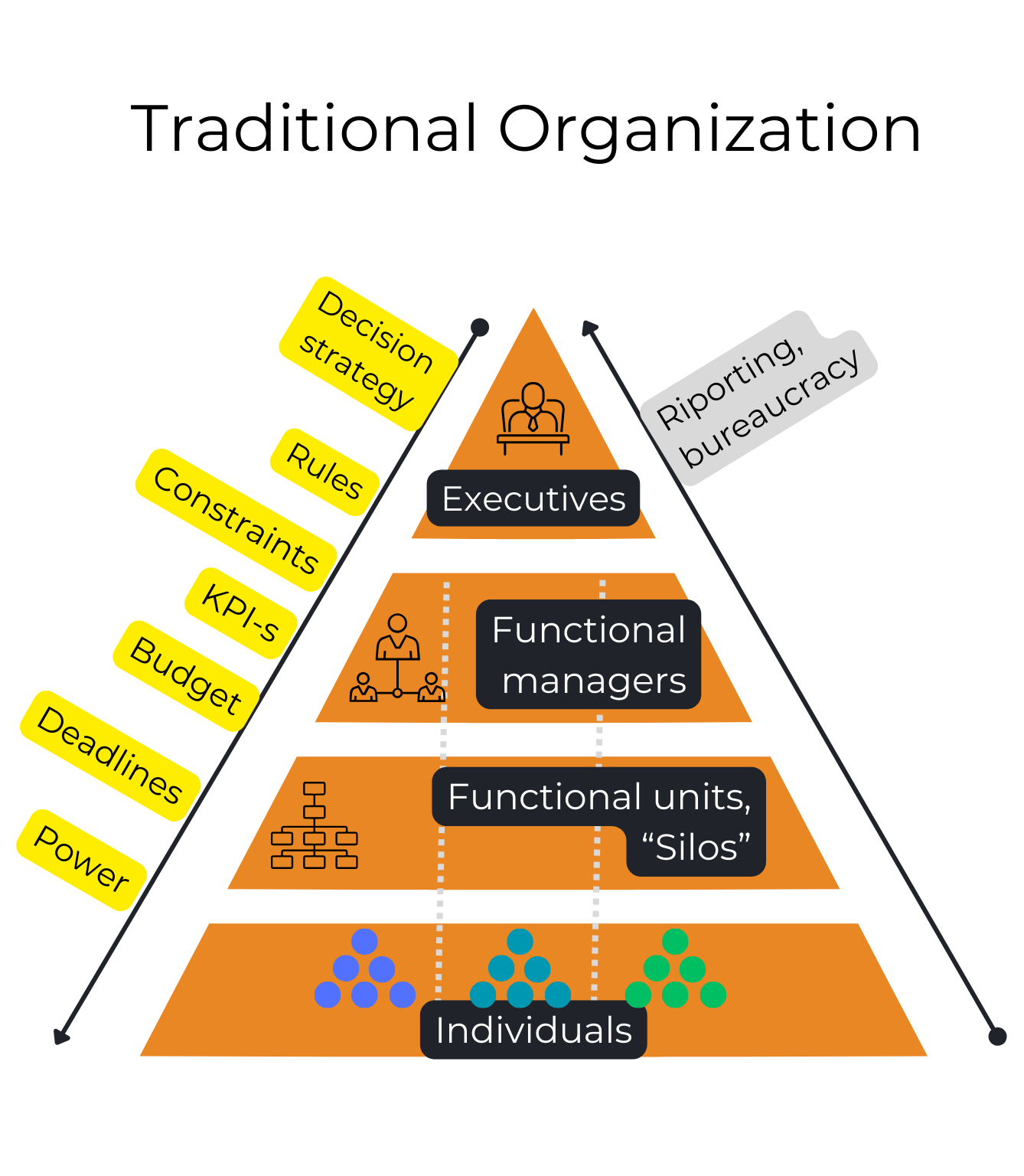
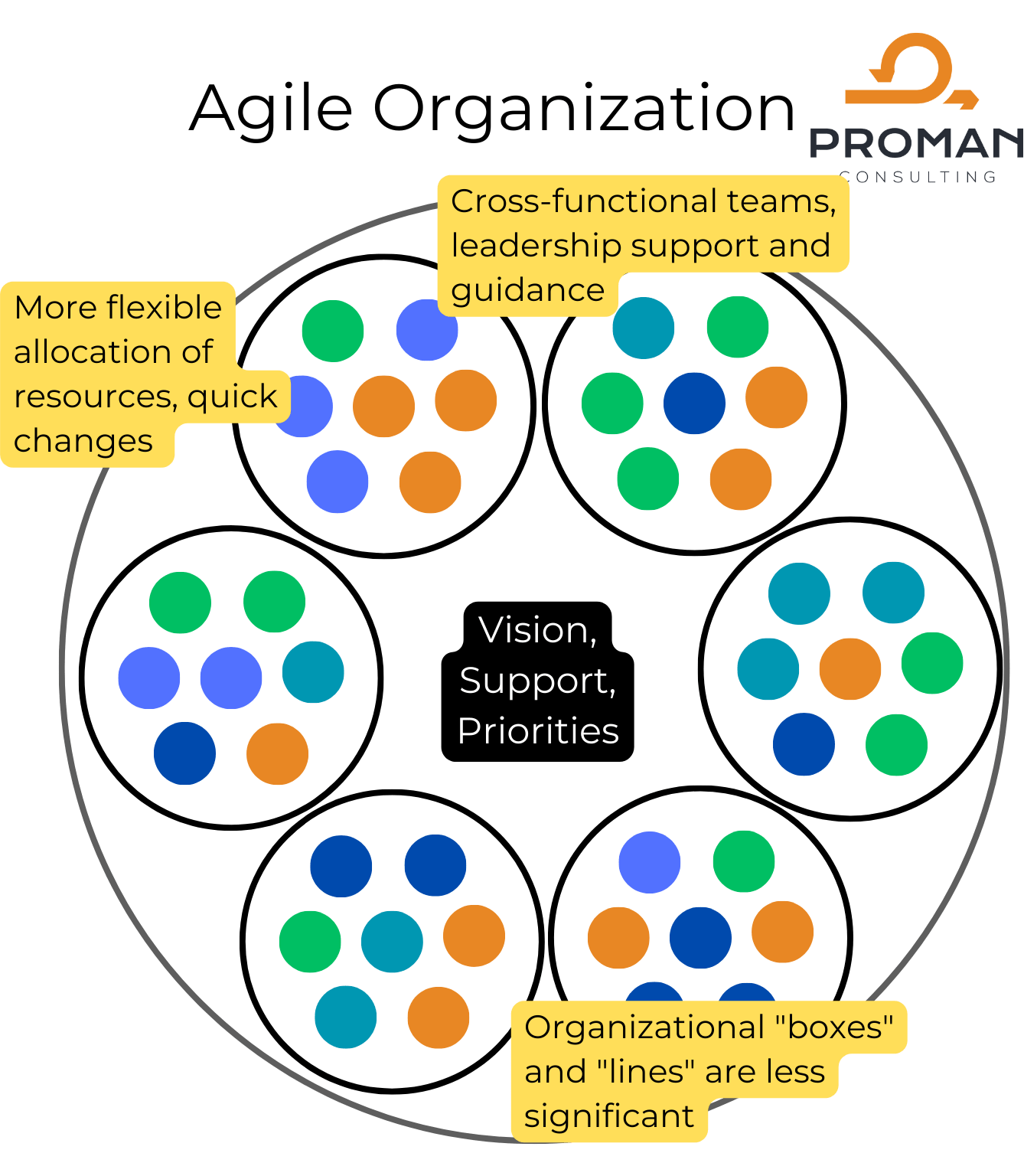
Move the slider to view before and after pictures
The organisational impact of agile transformation



The role of agile project management in agile transformation
An important element of agile transformation is the introduction of agile project management, which uses iterative and value-based operational frameworks such as Scrum or Kanban. But agile project management alone does not mean full organisational agility: true transformation requires changes at the level of leadership, decision-making and organisational structure.
How do we support agile transformations?
Organisations evolve organically, so our approach focuses on developing organisational culture through improvements in processes, ways of working, decision-making practices and the interactions that support them. For this reason, we view agile transformation not as a traditional change management project, but as a journey of continuous learning and organisational evolution.
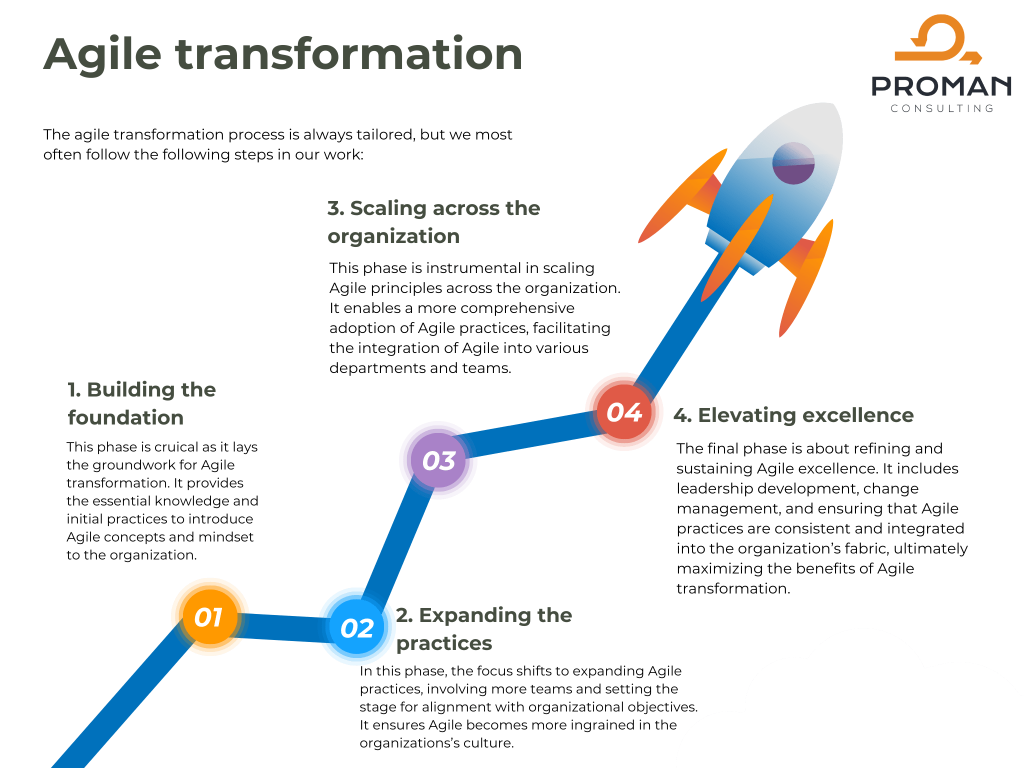
In agile transformations, we propose an evolutionary, small step-by-step transformation instead of large, simultaneous changes. This usually involves three main levels:
- Pilots - integrating working methods and tools into daily work
- Scaling tasks - Aligning strategy, measurement, operations and practices
- Improving corporate culture - developing corporate values and attitudes
Agile Transformation roadmap
Based on our experience of previous Agile transformations we have supported, we most often support transformations by developing the following "layers", the deeper, detailed elements of which are always tailored to the organisational characteristics and features.
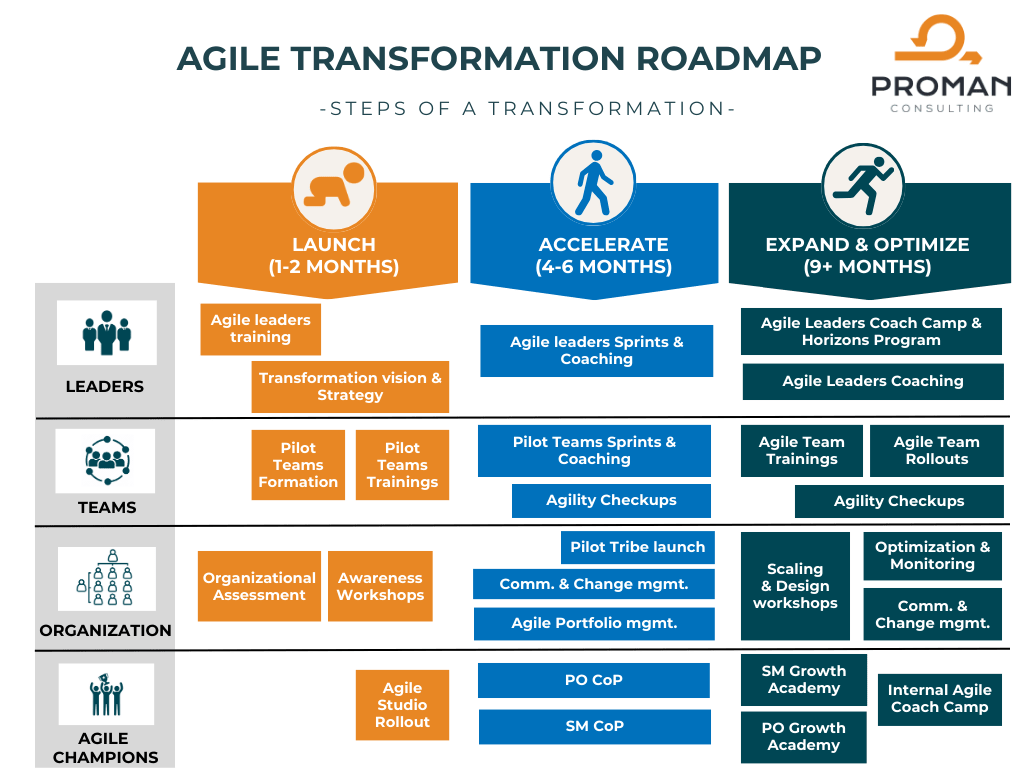
What are the layers of the agile transformation roadmap?
Leaders layer
Anyone who has been involved in a major change initiative knows that no change can happen without leadership support. This layer aims to:
- the highest possible level of leadership involvement,
- to ensure that the transformation is aligned with the organisational strategy and objectives,
- and to support leaders in changes in management practices.
We support the achievement of the above most often through agile leadership training, coaching series, transformational and strategic workshops, OKR (Objectives and Key Results) development where necessary, and "agile leaders sprints" to gain first-hand experience.
Team layer
Teamwork and collaboration are important characteristics of agile organisations. Our aim is to have high-performing teams in the organisation that are capable of meeting needs autonomously and to a high standard. In a larger organisation, this requires a change in working methods and mindset, which we propose to implement step-by-step. Typically, 2–6 pilot teams (depending on organisational size) can gain significant experience with agile delivery. These will both be of great help in the subsequent roll-out and help to "show" to organisational stakeholders the results that this modified way of working can deliver.
During the development process, we support teams with training, agile coaching and, if needed, assistance with role definition. Where required, we can also temporarily take on Scrum Master responsibilities and later hand them over to the team.
Organisation layer
To fully unlock the potential of agility, organisations need to align their organisational structures with team-level ways of working. This often requires structural changes that help reduce and break down organisational silos. By incorporating the lessons learned from pilot teams, we reshape team structures and the broader organisational design. Teams are typically organised around value streams or specific products and services. We follow a step-by-step transformation approach, making tribes and related teams scalable through conscious agile portfolio management and prioritisation, while avoiding disruptive “big-bang” transformations.
Agile champions layer
The transformations also aim to strengthen the characteristics of a learning organisation, which helps in continuous development. One good way to do this, in our experience, is to create "Agile Studios" and "Communities of Practice", through which the changed roles can continuously develop and share experiences, in the long run creating a circle of "Agile champions" who, as Agile coaches, will focus on the continuous improvement of the organisation without external support.
Agile development in practice
The essence of agile development is that teams work in short, iterative cycles with continuous feedback. Instead of large, one-off hand-offs, there is regular value delivery, allowing for rapid learning and continuous fine-tuning of direction. Frameworks such as Scrum or Kanban, support transparency, prioritisation and self-organising teamwork.
An important element of change is the launch of pilot teams, with 2-6 pilot teams, depending on the size of the organisation, gaining significant experience in agile delivery. These will both be of great help in the subsequent roll-out and will help to „show” to organisational stakeholders how this modified way of working can deliver results.
During development, we support the teams with training, agile coaching and, if required, support in role selection or even the initial Scrum Master tasks and subsequent handover.
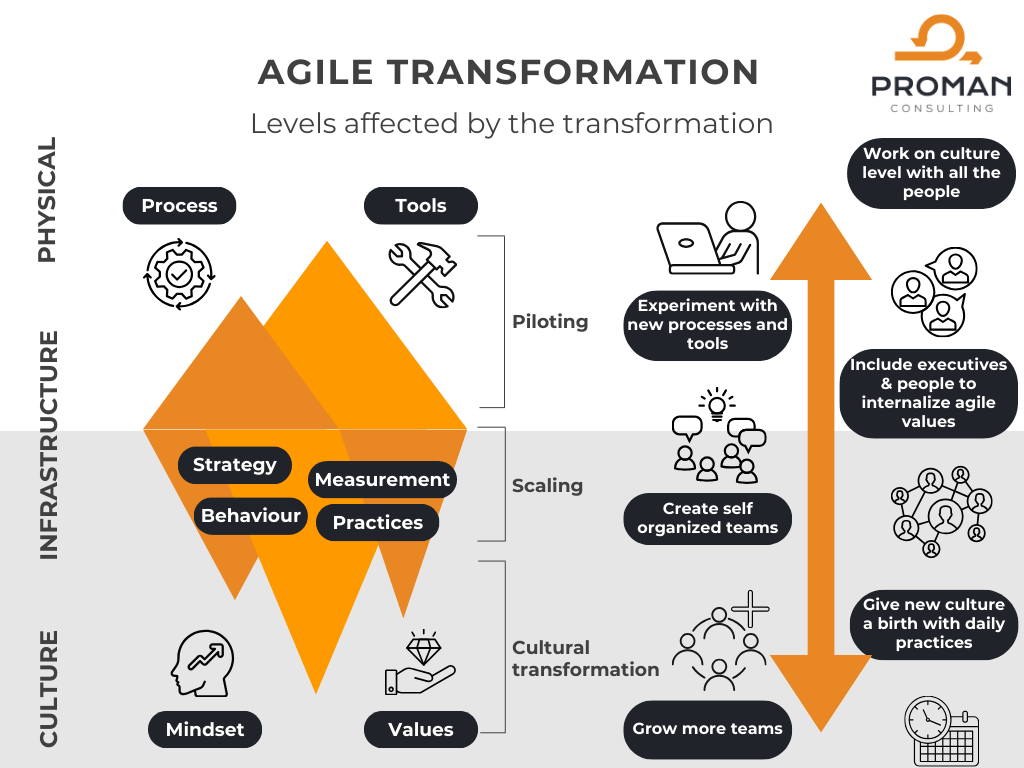
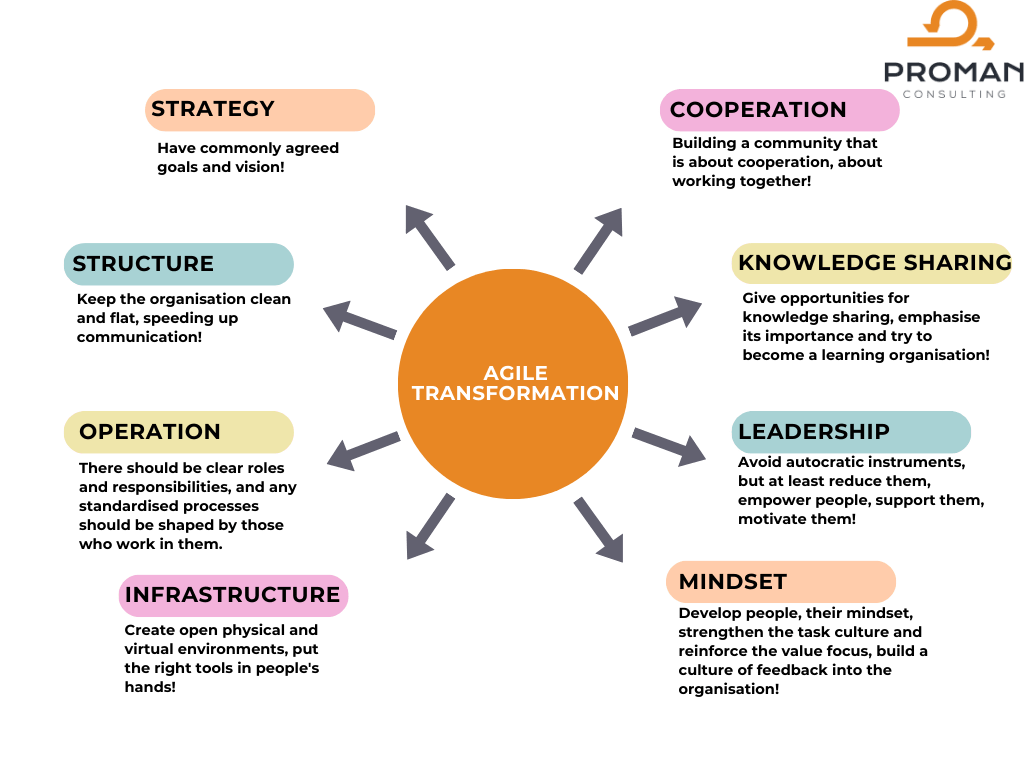
AREAS OFTEN AFFECTED BY AGILE TRANSFORMATIONS
To strengthen the above characteristics, change is most often needed. In most cases, this change is not limited to one element; in our experience, in most cases, it is appropriate to address several areas.
These elements illustrate how such a change can radically upend the life of the organisation, a process that should be undertaken very carefully. In our experience, developing the mindset is the most difficult task. We often hear that organisational culture needs to be improved. However, culture does not magically change, because it is the people who work in an organisation who shape it, consciously or unconsciously.
What results can we expect from an agile transformation?

Faster value delivery
The values and products delivered by the organisation get to the market faster, based on an iterative-incremental way of working. It is not possible to make miracles, but it is possible to get the results of product or service developments that are considered really important (even if they are not fully functional) into the hands of users as quickly as possible.
Higher
adaptability
Greater flexibility in scope, combined with a more rigorous approach to budgeting, will enable organisations to maintain or even increase their competitive advantage.


Customer focus
Stakeholders and teams work towards a common goal, with a primary focus on the unmet needs of customers that are constantly emerging. The teams adopt a "How about if we try it this way..." approach instead of "We can't do it because...".
Higher
empowerment
The teams are empowered to make decisions in a decentralised way, aligned with the organisational strategy and limitations. Managers are often wary of decentralised decision-making, but experience shows that even the most command-and-control minded manager recognises that his life is made easier, with more time for the really important, strategic decisions.


Cooperation and
transparency
Shared goals most often go beyond a single organisational unit, creating an organisation where different areas can work together across organisational "silos" to achieve common results with minimal dependencies. Management control alone is replaced by a radical transparency from which all members of the organisation can learn.
Clear
Focal points
The "let's do a little bit of everything" approach is being replaced by a "relentless focus on the most important things". No more hundreds of parallel projects pretending to be making progress, real results are being achieved.

How is an agile organisation different?
Traditional Organisation | AGILE ORGANISATION |
|---|---|
Functional, silo-based structure, task delivery focus | Team-based structure, value delivery focus |
Command & Control | Collaboration & teamwork |
Micro management, directive management | Servant leaders focusing on providing support |
Annual big bang planning | Rolling wave adaptive planning |
Think big, work on details, deliver the perfect | Think big, start small, evolve |
Bottom-up reporting, assumption and forecast driven decisions | Radical transparency, data driven decisions |
Long approval procedures | Fast, local decisions |
Limited tolerance for mistakes | Experimentation and learning from mistakes are opportunities |
Mechanical and permanent structure | „Living” organisation, that changes shape in line with strategies |
Focusing on individual performance | Focusing on team-based performance |
Investor mindset | Customer oriented mindset |
Frequently Asked Questions (FAQ)
How long can an agile transformation take?
It is important to set realistic expectations when starting an agile transformation – there is no “three-month miracle”. While the first tangible improvements – such as better collaboration, clearer prioritisation or faster decision-making – may appear within 3–6 months, the full organisational transformation typically takes 1–3 years to mature. The length of the journey largely depends on the organisation’s starting maturity level, leadership commitment and the depth of the changes involved.
At what size should an organisation consider an agile transformation?
Agile transformation is not limited to large enterprises. However, the operational complexity that often makes organisation-wide transformation necessary typically appears in companies with around 50–100 employees. At this stage, challenges such as organisational silos or slower decision-making tend to emerge. In smaller companies, the focus is usually on improving ways of working and mindset, while in larger organisations structural changes may also be required.
What are the risks of agile transformation?
The greatest risk is not the methodology itself, but its misinterpretation during implementation. A common mistake is when an organisation introduces agile tools – such as Scrum ceremonies – while leadership practices, decision-making processes and incentive systems remain unchanged. Another risk is a “big-bang” type transformation that attempts to move too quickly, as well as a lack of leadership commitment or an underestimation of organisational culture. If the change is not gradual, measurable and properly supported, it can lead to resistance and a loss of trust within the organisation.
How is the success of an agile transformation measured?
The success of an agile transformation cannot be captured by a single metric. Instead, it becomes visible across several interconnected areas. Key indicators may include shorter lead times, faster time-to-market, clearer prioritisation and fewer parallel initiatives. Other measurable outcomes include customer satisfaction, employee engagement, and the transparency and speed of decision-making. The real sign of success is that the organisation not only delivers faster, but operates with greater clarity, focus and intentionality.
Can an organisation in a regulated or highly hierarchical industry be agile?
Yes. Organisations in regulated or highly hierarchical industries can also adopt agile ways of working. Agility does not mean abandoning rules or compliance requirements, but improving decision-making, prioritisation and collaboration within the existing regulatory framework. Even in banking, insurance, the public sector or manufacturing, short feedback cycles, transparent backlogs and empowered teams can be introduced while maintaining compliance and control mechanisms. In these environments, agility often means building a consciously designed adaptive operating model rather than introducing radical structural change.